

I often see short expressions like “WTF” appear in chats when someone wants to react quickly without typing a full sentence. WTF meaning in chat is usually “what the fuck,” a vulgar slang expression used to show strong surprise, confusion, disbelief, frustration, anger, or annoyance.
Cambridge and Oxford both describe it as an offensive slang abbreviation commonly used in text messages and social media.I find that the exact emotion depends heavily on the surrounding words, punctuation, relationship, and situation.
Someone might type “WTF happened?” because they are genuinely confused, while “WTF 😂” can express amused disbelief. I created this guide to help you understand the meaning, emotional shades, examples, appropriate contexts, alternatives, and important limitations of WTF meaning in chat before you use it yourself.
Quick Answer: WTF Meaning in Chat
- WTF usually means “what the fuck.”
- I use it as an informal reaction to surprise, confusion, disbelief, frustration, anger, or shock.
- I consider it vulgar and inappropriate for most professional, academic, and formal communication.
- The surrounding message determines whether WTF sounds funny, confused, annoyed, shocked, or aggressive.
- In some contexts, people use WTF simply to intensify a question or reaction.
What Does WTF Mean in Chat?
When I explain WTF meaning in chat, I describe it as a written initialism for “what the fuck.” Dictionaries classify it as slang or offensive slang and note that it is especially common in texts, social media, and other informal digital communication.
I usually see WTF functioning as an emotional reaction rather than a literal request for information. Depending on the conversation, it can communicate several related feelings.
- Surprise: “WTF! I didn’t expect that.”
- Confusion: “WTF is going on?”
- Disbelief: “WTF, is this actually real?”
- Frustration: “WTF, my internet stopped again.”
- Anger: “WTF did you just say?”
- Shock: “WTF! That was completely unexpected.”
- Amused disbelief: “WTF 😂 How did you even do that?”
I always recommend reading the entire message before deciding what the sender means emotionally.
WTF Meaning in Chat: Different Meanings by Context
I find that WTF meaning in chat can change slightly depending on the situation, even though the underlying phrase remains the same. The three letters do not automatically tell me whether the sender is angry, amused, confused, or simply surprised.
| Context | Meaning | Typical Tone | Best Interpretation |
|---|---|---|---|
| Unexpected news | What the fuck? | Shocked | Strong surprise |
| Confusing situation | What the fuck? | Confused | “What is happening?” |
| Annoying problem | What the fuck? | Frustrated | Strong irritation |
| Strange behavior | What the fuck? | Disbelieving | “Why did that happen?” |
| Funny situation | What the fuck? | Amused | Playful disbelief |
| Argument | What the fuck? | Angry | Confrontational reaction |
| Social media post | What the fuck? | Variable | Depends on surrounding content |
I pay close attention to punctuation because “WTF?” can feel like a direct question, while “WTF!!!” can communicate intense shock or frustration. A message such as “WTF 😂” can soften the emotional impact by making the reaction look humorous.
Is WTF a Bad Word or a Swear Word?
I treat WTF as a profanity-based expression because the final word in its full form is a vulgar swear word. Cambridge specifically labels the expression offensive slang, while Collins describes it as an abbreviation of a taboo expression.
I would therefore avoid assuming that abbreviations are automatically polite simply because they hide the full word. Many readers immediately understand what WTF represents, so the abbreviation can still carry the same informal and offensive force.
I usually consider these factors before using it:
- Relationship: Close friends may accept it more easily.
- Setting: Casual chats allow more slang than formal settings.
- Audience: Parents, teachers, clients, managers, or unfamiliar people may interpret it differently.
- Tone: A joke can still sound rude if the reader does not know your intention.
- Platform: Informal social media spaces generally tolerate more slang.
For respectful communication, I prefer alternatives such as what happened, what is going on, seriously, what in the world, or what the heck.
WTF Origin and Etymology
I find the documented digital history of WTF particularly interesting because the abbreviation became strongly associated with early online communication. A documented Usenet example dates to 1985, showing WTF being used as shorthand for “what the fuck.”
I would not claim that one person definitely invented the abbreviation because the historical record does not establish a single creator. The underlying phrase is older than the internet, while the abbreviated form became increasingly useful in fast digital conversations.
I also distinguish WTF from another meaning sometimes associated with the same letters. World Taekwondo Federation historically used WTF as its abbreviation, although the organization later adopted the name World Taekwondo.
For modern chat and texting, however, I normally interpret WTF as the slang expression unless the surrounding subject clearly indicates another meaning.
How I Interpret WTF in Text Messages
When I receive WTF in a text, I first look at the words surrounding it rather than interpreting the abbreviation by itself. The same three letters can communicate very different emotions.
For example:
- “WTF happened?” usually signals confusion or disbelief.
- “WTF!” can signal shock, anger, or surprise.
- “WTF 😂” often sounds amused or playful.
- “WTF are you doing?” can sound confrontational.
- “WTF, that’s amazing!” can express excited disbelief.
- “WTF is this?” may communicate confusion, criticism, or disgust.
I also consider punctuation and emojis. Capital letters and multiple exclamation marks can make the reaction feel stronger, while laughing emojis can make an otherwise aggressive-looking expression seem playful.
WTF on Social Media, Snapchat, TikTok, and Messaging Apps
I commonly encounter WTF across informal digital platforms, including social media comments, private messages, group chats, gaming conversations, and online communities. Its short format makes it useful when someone wants to react instantly to surprising or confusing content.
I might interpret the expression differently depending on the platform and conversation.
- On Snapchat, it may be a quick reaction to a surprising picture.
- On TikTok, it may respond to an unexpected video.
- In a group chat, friends may use it jokingly.
- In gaming, it can express frustration about an unexpected event.
- On Instagram, it may react to a surprising post or story.
- In private texting, it can express anything from confusion to anger.
I never assume that WTF automatically means the sender is angry. Context, emojis, punctuation, and the relationship between the people involved all help me determine the intended tone.
Can WTF Be Used in a Professional Email?
I would generally avoid using WTF in a professional email, workplace message, academic assignment, business proposal, or formal customer communication. Even if the sender intends it humorously, the profanity can make the message sound disrespectful or overly casual.
For example, I would not recommend writing:
“WTF happened to the report?”
In a workplace setting, I would instead write:
“Could you please explain what happened to the report?”
I see this difference as important because professional communication depends on clarity and audience awareness. A phrase that works between close friends can create an entirely different impression when directed toward a manager, customer, teacher, colleague, or client.
Casual Examples of WTF in Chat
I use examples to show how much the surrounding context affects the meaning. Here are several natural conversational patterns.
- Friend: “WTF, you won the lottery?”Meaning: The person is extremely surprised.
- Friend: “WTF happened last night?”Meaning: The person wants an explanation about a confusing event.
- Friend: “WTF 😂 You actually bought it?”Meaning: The person is surprised and amused.
- Friend: “WTF is taking so long?”Meaning: The person is frustrated about a delay.
- Friend: “WTF, that movie ending was crazy.”Meaning: The person is expressing strong surprise or disbelief.
- Friend: “WTF are you talking about?”Meaning: The person is confused and may also sound irritated.
I would always judge these examples by the relationship between the speakers because tone is not determined by the abbreviation alone.
Formal Communication Example
I find it useful to compare casual and professional communication because this is where misunderstandings often occur. Imagine that a colleague sends an incorrect document shortly before an important meeting.
A casual friend might text:
“WTF, you sent the wrong file 😂”
In a professional setting, I would write:
“I think the wrong file was attached. Could you please send the correct version?”
Both messages communicate that something unexpected happened, but the second version removes profanity and creates a more respectful professional tone.
I use this distinction as a simple rule: if I would hesitate to say the full phrase directly to someone in a formal setting, I should probably avoid sending the abbreviation there too.
WTF vs Similar Expressions
I often compare WTF with milder expressions because readers sometimes want the same emotional meaning without profanity.
| Expression | Basic Meaning | Tone | Best Use Case | Key Difference |
|---|---|---|---|---|
| WTF | What the fuck | Strong, vulgar | Very casual chats | Strongest profanity |
| WTH | What the heck/hell | Milder | Casual conversations | Less offensive |
| What? | Asking for clarification | Neutral | Most settings | Much less emotional |
| Seriously? | Strong disbelief | Casual to neutral | Surprise or doubt | No profanity |
| What happened? | Asking for an explanation | Neutral | Everyday communication | Direct and clear |
| What in the world? | Strong surprise | Mild | Casual conversation | Polite alternative |
I usually choose WTH, seriously, or what happened when I want to preserve the reaction without using profanity.
WTF vs WTH: What Is the Difference?
I see WTF and WTH used in similar situations, but I treat them differently because their level of profanity is not the same. WTF represents “what the fuck,” while WTH is commonly used as a milder alternative meaning “what the heck” or “what the hell.”
I would use WTF only when the conversational setting is clearly informal and the people involved are comfortable with profanity. I would choose WTH when I want a similar feeling of surprise or confusion but want to reduce the offensive tone.
For example:
- WTF is happening? — stronger and vulgar.
- WTH is happening? — milder.
- What is happening? — neutral.
I find this distinction useful when choosing language for different audiences.
Can WTF Mean Something Other Than What the Fuck?
I know WTF can have meanings outside internet slang, so I always check the subject before interpreting it. In modern casual chat, the slang meaning is usually the relevant one, but the abbreviation has also been used for names and organizations.
One historical example is the World Taekwondo Federation, which used WTF as its abbreviation before the organization became known as World Taekwondo.
I also recognize that acronyms can have specialized meanings in technical, organizational, sports, or professional contexts. That is why I do not interpret every occurrence of WTF as profanity without considering the surrounding subject.
Common Mistakes I See When People Use WTF
I see several misunderstandings when people encounter WTF for the first time. Most happen because readers focus on the letters instead of the social context.
- Mistake 1: Assuming WTF always means anger. I know it can also express surprise, confusion, disbelief, amusement, or frustration.
- Mistake 2: Assuming it is polite because it is abbreviated. I still treat it as profanity-based slang.
- Mistake 3: Using it with everyone. I would avoid it with unfamiliar people or in formal settings.
- Mistake 4: Ignoring punctuation. “WTF?” and “WTF!!!” can communicate different emotional intensity.
- Mistake 5: Ignoring emojis. “WTF 😂” may sound playful rather than hostile.
- Mistake 6: Assuming every WTF has the slang meaning. I check the subject for possible organizational or specialized meanings.
How Should I Reply When Someone Sends WTF?
When someone sends me WTF, I first identify the emotion behind the message. If the person appears confused, I provide an explanation; if they appear frustrated, I respond calmly rather than matching their intensity.
For example:
- “WTF happened?” → “The server went down for about ten minutes.”
- “WTF 😂” → “I know! I couldn’t believe it either.”
- “WTF is this?” → “It’s the updated version of the document.”
- “WTF are you doing?” → “I’m fixing the settings. Give me a minute.”
I find that answering the underlying question is usually more useful than focusing on the profanity. If the tone seems hostile, I keep my response clear and calm.
Is WTF Appropriate for Everyone?
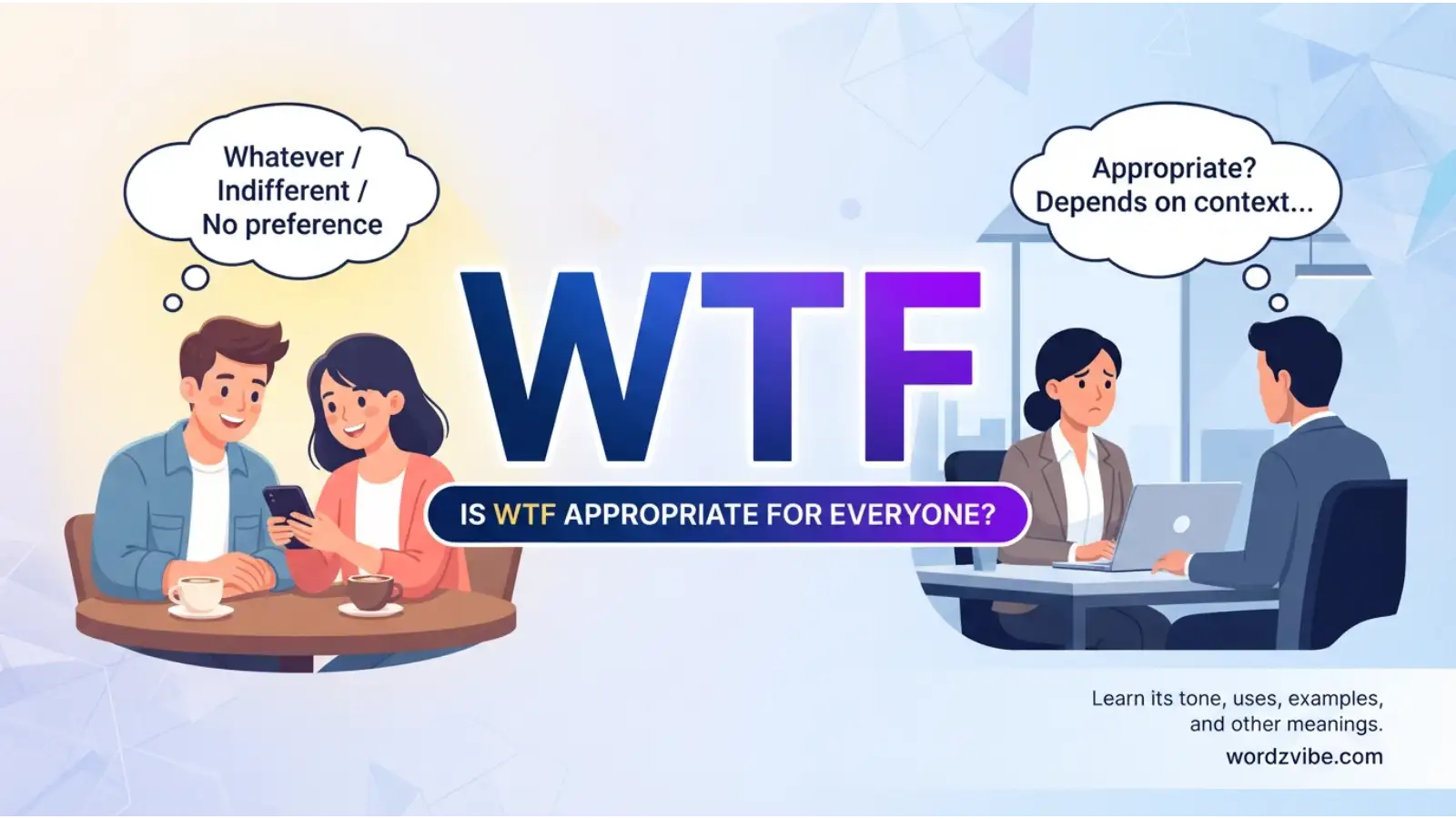
I would not describe WTF as universally appropriate because language depends on audience, relationship, culture, and setting. Someone may consider it harmless internet slang, while another person may consider the underlying profanity offensive.
I recommend thinking about the communication environment before using it.
- Close friends: Often acceptable if both people are comfortable with profanity.
- Private casual chats: Usually informal enough for slang.
- Public social media: Depends on the audience and platform.
- Workplace: Usually better to avoid it.
- School or academic writing: I would avoid it unless discussing the term itself.
- Business communication: I would choose a neutral alternative.
- Customer service: I would avoid it completely.
I believe the safest approach is to match the formality of the setting rather than assuming that everyone interprets slang in the same way.
People Also Ask About WTF Meaning in Chat
1. What does WTF mean in chat?
I use WTF as an abbreviation for “what the fuck.” It commonly expresses surprise, confusion, disbelief, frustration, anger, or shock in informal digital communication.
2. Is WTF a bad word?
I consider WTF profanity-based slang because its full form contains the vulgar word “fuck.” The abbreviation is common online, but I would still avoid it in formal or professional communication.
3. What does WTF mean from a girl or guy?
I would not assign a different dictionary meaning based on whether the sender is a girl or a guy. I interpret WTF according to the message, context, punctuation, emojis, and relationship between the people communicating.
4. Does WTF always mean anger?
I would not interpret WTF as anger automatically. I also see it used for surprise, confusion, disbelief, frustration, shock, amusement, and other strong reactions.
5. Is WTF appropriate in a professional chat?
I would generally avoid WTF in professional chats because the underlying phrase is vulgar. I would use alternatives such as what happened, could you clarify, seriously, what is going on, or what the heck depending on the situation.
Final Thoughts
I see WTF meaning in chat as a good example of how three letters can carry a surprisingly wide range of emotions. Although the basic meaning is “what the fuck,” the actual message can communicate surprise, confusion, disbelief, frustration, anger, shock, or even humor depending on the context.
I always encourage readers to look beyond the abbreviation itself. The relationship between the speakers, surrounding words, punctuation, emojis, and communication setting can completely change how WTF feels to the person receiving it.
For casual conversations with people who are comfortable with profanity, WTF can be a quick and expressive reaction. For professional, academic, or unfamiliar audiences, I prefer clearer and more respectful alternatives.

My name is Muhammad Waseem, author at WordzVibe.com. With a Master’s degree in English and over 6 years of linguistic experience, I break down modern digital terms, viral slang, and word meanings into simple language. Every definition on this site is personally researched, written, and verified by me to ensure full accuracy and reliability.
1 thought on “WTF Meaning in Chat: What Does WTF Mean in Texting”