

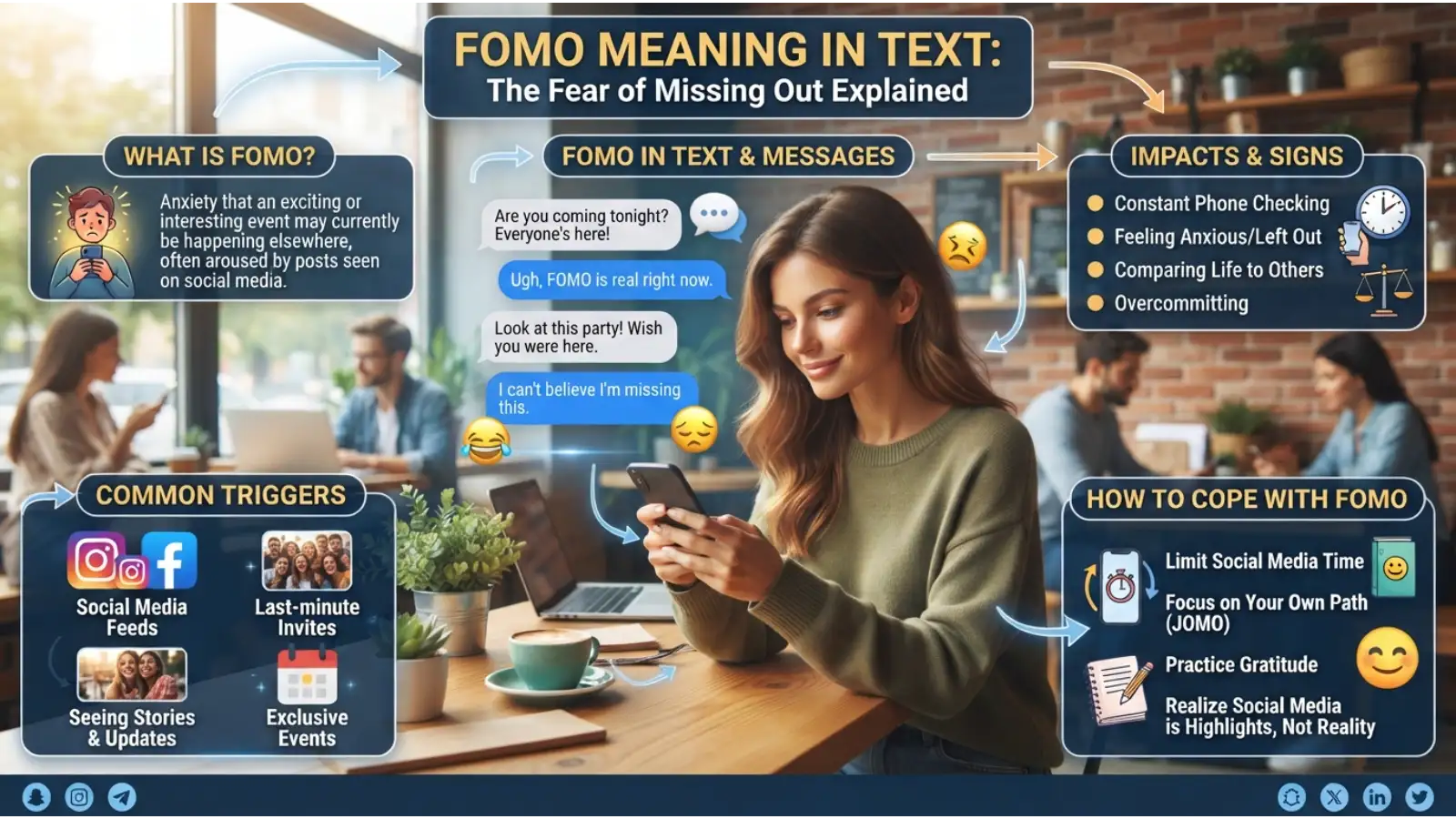
When someone texts me, “I have FOMO, so I might go,” I understand it as more than simply wanting to attend an event. They are worried that they will miss something enjoyable, exciting, or important while other people get to experience it. FOMO meaning in text usually, fear of missing out, and it is commonly used in casual texting, online conversations, and social media.
In everyday messages, FOMO can describe anything from skipping a party to missing a concert, trip, sale, game, or group activity. The feeling can be serious, but people also use the word casually or jokingly.
Context matters because “I have FOMO” might express genuine anxiety, playful regret, or simply a strong desire to join in. If you see FOMO in a text, the safest interpretation is usually that the person does not want to feel left out.
Quick Answer
FOMO in text means “fear of missing out.” It describes the worried or uneasy feeling that you might miss an enjoyable, interesting, or important experience while other people are taking part. The abbreviation is informal and is especially common in texting and online communication.
What Does FOMO Stand For?
FOMO stands for Fear of Missing Out. It is an informal abbreviation and is also commonly treated as an acronym in everyday language.
The expression describes concern about missing an experience that other people are enjoying. Dictionaries specifically connect the term with situations involving events, opportunities, and experiences that someone believes they may miss.
What Does FOMO Meaning in Texting?
In texting, FOMO usually means that someone feels they might miss out on something enjoyable or worthwhile.
For example, a friend might text, “I wasn’t planning to go, but now I have FOMO.” They are saying that seeing or hearing about the event has made them want to participate.
It does not necessarily describe intense fear. In casual texting, FOMO is often used playfully to mean, “I don’t want to be left out.”
Is FOMO Considered Slang?
FOMO is informal internet and conversational language, but it is more established than many temporary pieces of texting slang.
Major dictionaries list FOMO as an informal abbreviation or noun. It can appear in conversations, articles, advertising, and other forms of everyday communication.
So, I would describe FOMO as an informal abbreviation that has become widely recognized, rather than treating it as obscure slang.
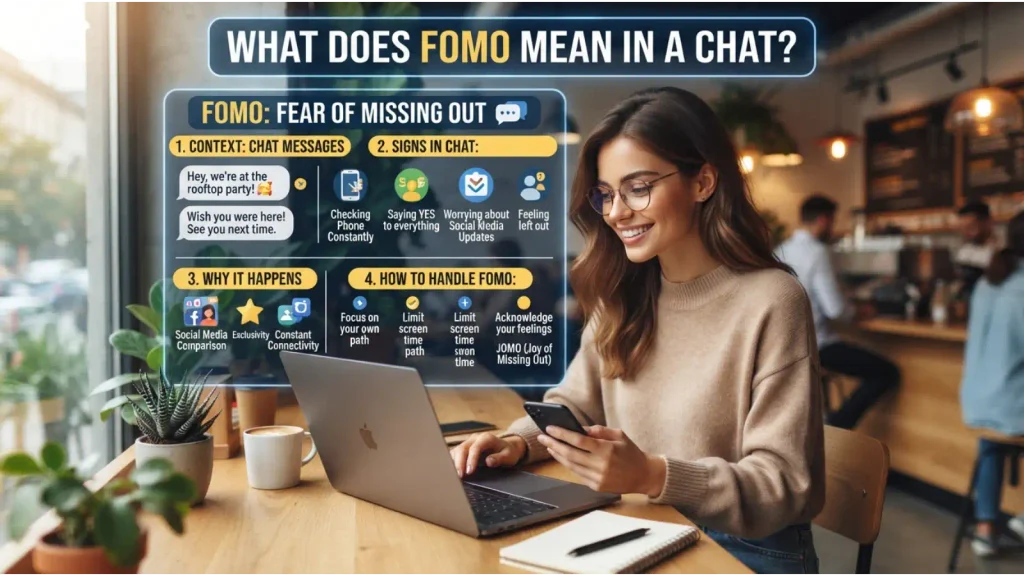
What Does FOMO Meaning in a Chat?
In a chat, FOMO usually communicates a desire not to miss something.
Someone might say, “Everyone is going tonight and now I have FOMO.” The speaker probably feels left out because other people are going somewhere without them.
The meaning can be emotional or humorous. A person might genuinely regret missing an event, or they might simply be teasing themselves for wanting to join.
What Tone Does FOMO Have?
FOMO can have several tones depending on the conversation.
FOMO can sound serious when someone is genuinely worried about being excluded. It can sound playful when a person jokes about wanting to attend a party or buy something.
It can also be casual, humorous, excited, or slightly anxious. The surrounding message, punctuation, emojis, and relationship between the speakers can help reveal the intended tone.
Is FOMO Positive or Negative?
FOMO itself usually describes an uncomfortable feeling, so it often has a negative or uneasy emotional side.
However, the word does not always sound negative in conversation. Someone might say, “I have vacation FOMO” while joking about seeing a friend’s travel photos.
The actual emotional meaning depends on the situation. FOMO can express genuine anxiety, mild regret, playful envy, or simply a strong desire to participate.
Can FOMO Sound Rude?
FOMO is not inherently rude.
If someone says, “I got FOMO when I saw your photos,” the comment can actually sound friendly and enthusiastic. They may be saying that they wished they had joined you.
Tone can change if FOMO is used sarcastically or to criticize someone. As with many informal expressions, context matters more than the abbreviation itself.
How Is FOMO Used on Social Media?
Social media is strongly associated with FOMO because people regularly see photos, videos, announcements, and updates about experiences they are not part of.
For example, someone may see friends posting from a concert and write, “Major FOMO right now.” The phrase communicates that they wish they were there.
Dictionary definitions also specifically connect FOMO with experiences people see through social media.
How Do People Use FOMO in Everyday Conversation?
FOMO can describe many ordinary situations.
Someone can have FOMO about a party, restaurant opening, vacation, sporting event, concert, shopping deal, movie, game, or group outing.
For example:
“I wasn’t going to the concert, but now I have FOMO.”
Here, FOMO means the speaker has started feeling that they may regret missing the concert.
FOMO Text Message Examples
Here are some natural examples:
“Everyone’s going out tonight. I have FOMO now.”
The person wishes they could join the group.
“Seeing your vacation pictures is giving me FOMO.”
The speaker wishes they were enjoying the same trip.
“I said no to the party, but I’m already getting FOMO.”
The person is beginning to regret staying home.
“Don’t post too many pictures. You’re giving me serious FOMO.”
This is usually playful and means the photos are making the speaker wish they were there.
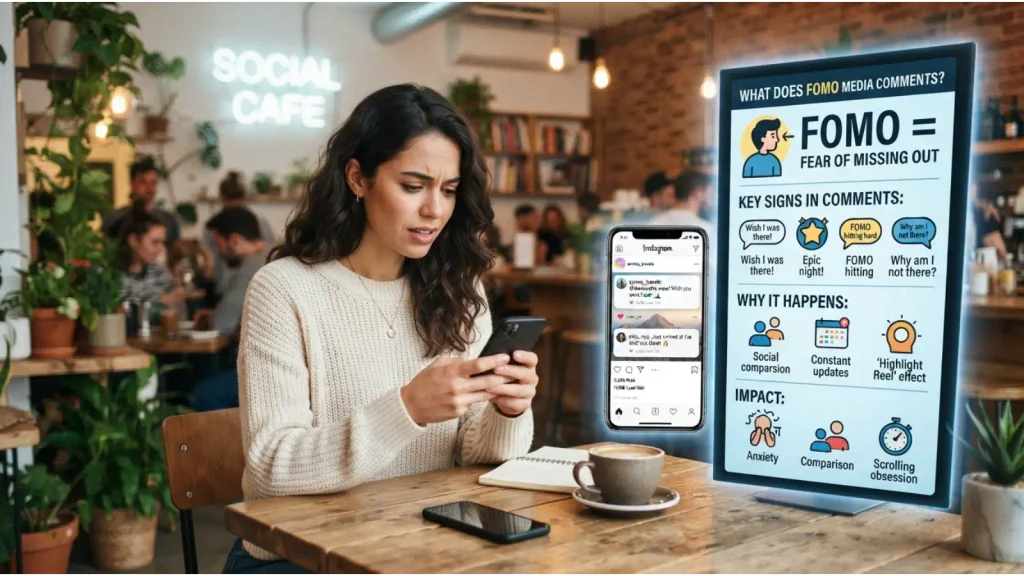
What Does FOMO Mean in Social Media Comments?
In a social media comment, FOMO often means, “I wish I were there.”
A person might comment “FOMO!” underneath photos from a wedding, concert, trip, dinner, or other event.
It can be a short way to express interest without writing a full sentence. The exact emotional strength depends on the post and the relationship between the people involved.
How Does Context Change the Meaning of FOMO?
The basic meaning remains the same, but context can show what kind of missing out the speaker has in mind.
If someone writes “concert FOMO,” they probably wish they had attended a concert. If they write “travel FOMO,” they may be comparing their own plans with someone else’s trip.
The phrase can therefore describe missing a specific event or a broader feeling that other people are experiencing something desirable.
When Should You Use FOMO?
Use FOMO when talking casually about the feeling of not wanting to miss something.
It works naturally in texts, group chats, social media comments, and conversations with friends.
For example, “I have FOMO about the game tonight” sounds natural in casual communication. The expression is especially useful when a shorter phrase communicates the feeling better than a long explanation.
When Should You Avoid FOMO?
Avoid FOMO when the audience may not understand informal abbreviations.
In a formal report, official letter, academic paper, or highly professional communication, a clearer phrase such as fear of missing out may be more appropriate.
That does not mean FOMO is universally inappropriate at work. It depends on the workplace and the people involved, but the full phrase is safer when clarity and formality matter.
Is FOMO Appropriate at Work?
FOMO can appear in casual workplace chats, especially among colleagues who already use informal language.
For example, a coworker might say, “I have FOMO after seeing everyone’s conference photos.”
However, I would avoid assuming that every professional audience knows the abbreviation. In formal communication, writing “fear of missing out” the first time can make the meaning immediately clear.
How Should You Reply to FOMO?
Your reply should match the situation.
If a friend says, “I have FOMO about tonight,” you could respond:
Friendly: “You should come with us!”
Reassuring: “Don’t worry, we’ll tell you everything.”
Funny: “FOMO has officially won.”
Casual: “Come along if you can!”
The best response depends on whether the person wants an invitation, reassurance, or simply wants to joke about missing the event.
FOMO vs JOMO
JOMO means joy of missing out, while FOMO means fear of missing out.
| Term | Meaning | Tone | Common Use |
|---|---|---|---|
| FOMO | Fear of missing out | Anxious, regretful, playful | Wanting to join an experience |
| JOMO | Joy of missing out | Relaxed, positive | Feeling happy about staying away |
The two expressions describe contrasting attitudes toward missing an experience. FOMO focuses on concern about being left out, while JOMO emphasizes being comfortable with not participating.
1. FOMO vs Envy
Envy & FOMO can overlap, but they are not identical.
FOMO focuses on the fear that you are missing an experience or opportunity. Envy is a broader feeling that someone else has something desirable that you would like.
For example, seeing a friend’s vacation may give you FOMO because you wish you had gone. You might also feel envy because you want the enjoyable experience they are having.
Common Misunderstandings About FOMO
One common mistake is assuming that FOMO always means serious anxiety.
In everyday texting, people often use it casually. “I have FOMO because I skipped brunch” may simply mean, “I wish I had gone.”
Another misunderstanding is thinking that FOMO only relates to social media. Social media can contribute to the feeling, but people can experience FOMO around ordinary events and opportunities without using social platforms.
Where Did the Term FOMO Come From?
The history of FOMO has more than one attribution, so its origin should be described carefully.
Marketing strategist Dan Herman has described identifying the underlying phenomenon in the 1990s and using the phrase in his work. Patrick McGinnis, meanwhile, says he coined the acronym FOMO in a 2004 Harvard Business School student publication. Harvard Business School also identifies McGinnis with the 2004 use of the term.
The safest explanation is that the phrase and concept have an earlier history, while McGinnis is strongly associated with the 2004 popularization of the acronym in student and business-school culture.
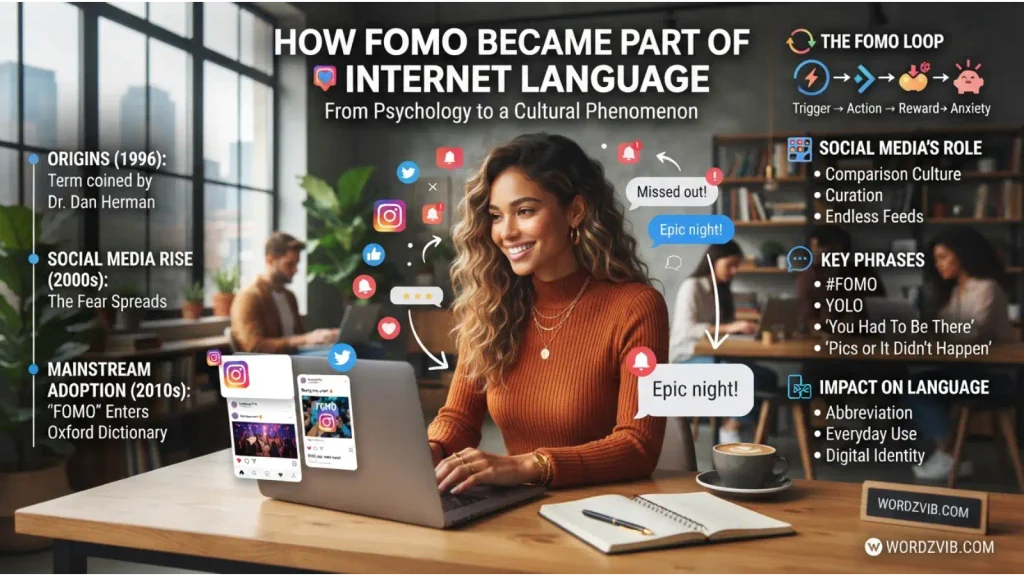
How FOMO Became Part of Internet Language
FOMO became closely associated with internet and social media communication as people gained more ways to see what others were doing.
The term is now used beyond social media, including conversations about travel, entertainment, shopping, events, and opportunities.
Its usefulness comes from its compact meaning. Three or four letters can communicate the idea that someone does not want to miss an experience.
Is FOMO Still Used Today?
Yes, FOMO remains an established informal term in English.
Current dictionary entries from Cambridge, Oxford, and Collins recognize the expression, and it appears in everyday writing and speech.
Its meaning has also become broader than simply missing a party or social event. People can talk about FOMO involving opportunities, experiences, purchases, travel, entertainment, and many other situations.
Frequently Asked Questions
1. What does FOMO mean in text?
FOMO means fear of missing out. In a text, it usually describes the feeling that you might miss an enjoyable, interesting, or important experience while other people are participating.
2. What does FOMO stand for in texting?
FOMO stands for fear of missing out. It is an informal abbreviation commonly used in texts, chats, social media posts, and casual conversations.
3. Is FOMO a slang word?
FOMO is informal language and is often described as slang or internet language, but it is also established enough to appear in major English dictionaries.
4. Is FOMO positive or negative?
FOMO usually describes an uneasy feeling about missing something, but the tone can be playful or humorous in casual conversation. Context determines how serious the expression sounds.
5. How should I reply when someone says they have FOMO?
A suitable reply depends on the situation. You might invite them, reassure them, or respond humorously. For example, “Come with us!” works if an invitation is possible, while “We’ll tell you all about it” can be reassuring.
Final Thoughts
What does FOMO mean in text? It means fear of missing out, usually describing the feeling that you may miss an enjoyable or worthwhile experience while other people are taking part.
I would read FOMO as a flexible, informal expression rather than automatically treating it as serious anxiety. A message such as “I have FOMO” can express genuine concern, playful regret, excitement, or simply a wish to be included. The surrounding conversation usually tells you which meaning fits best.

My name is Muhammad Waseem, author at WordzVibe.com. With a Master’s degree in English and over 6 years of linguistic experience, I break down modern digital terms, viral slang, and word meanings into simple language. Every definition on this site is personally researched, written, and verified by me to ensure full accuracy and reliability.