


SMFH is an internet abbreviation people use in text messages and online conversations to express frustration, disbelief, disappointment, or annoyance. If someone sends you “SMFH,” they are usually reacting to something they find ridiculous, irritating, or hard to believe.
The phrase “what does smfh meaning in text” points to a common question about online slang: what the abbreviation stands for and how it changes the tone of a message.
SMFH is a stronger, more emphatic version of SMH, but its exact tone depends on the conversation. Understanding the context can help you tell if someone is joking, genuinely frustrated, or criticizing a situation.
Quick Answer
SMFH stands for “shaking my f***ing head.” In texting, people use it to express strong disappointment, frustration, disbelief, or annoyance. It is an informal expression that includes profanity, making it more emphatic than SMH, which means “shaking my head.”

What Does SMFH Stand For?
SMFH stands for “shaking my fing head.”* The letter F represents an intensifier that adds profanity and makes the expression stronger.
People use it when a situation seems foolish, frustrating, disappointing, or unbelievable. It communicates a reaction rather than describing a literal action.
For example, someone might text:
- “He forgot his own birthday plans. SMFH.”
- “They canceled the event five minutes before it started. SMFH.”
- “You really paid twice for the same order? SMFH.”
In each example, the sender expresses a stronger reaction than simple surprise. Depending on the relationship, the message may sound humorous, irritated, or judgmental.
What Does SMFH Mean in Texting?
In texting, SMFH usually expresses a strong reaction to something that has gone wrong or seems unreasonable.
Friends might use it when sharing frustrating stories, reacting to bad decisions, or joking about everyday mistakes. It can also appear in group chats and social media comments.
Consider this conversation:
Alex: I left my lunch at home again.
Jamie: SMFH 😂
Here, Jamie is probably teasing Alex rather than expressing serious anger. The laughing emoji softens the response and makes it more playful.
Without an emoji or friendly context, however, SMFH may sound more critical or annoyed.
What Tone Does SMFH Have?
SMFH generally communicates a negative reaction, but the exact tone depends on the situation.
- Frustrated: “The internet stopped working during my meeting. SMFH.”
- Disappointed: “He promised to help and never showed up. SMFH.”
- Sarcastic: “Another password reset? SMFH.”
- Playful: “You put salt in your coffee instead of sugar? SMFH 😂”
- Disapproving: “They ignored the safety rules again. SMFH.”
The expression is usually informal and emphatic. It can make a message sound harsher than the sender intends, especially when the recipient is already upset.
Pay attention to the surrounding words, emojis, and your relationship with the sender before deciding how seriously to take it.
SMFH vs. SMH: What Is the Difference?
SMFH and SMH communicate similar reactions, but SMFH adds profanity for emphasis.
| Abbreviation | Full Form | Typical Tone |
|---|---|---|
| SMH | Shaking my head | Disappointed, disapproving, or surprised |
| SMFH | Shaking my f***ing head | More emphatic, frustrated, or annoyed |
For example:
- “You forgot your keys again. SMH.”
- “You forgot your keys again after I reminded you three times. SMFH.”
The second message sounds more exasperated. Still, SMFH is not automatically angry; friends may use it humorously when teasing each other.
Is SMFH Rude or Offensive?
SMFH can sound rude because its full form contains profanity. However, the level of offense depends on the audience, relationship, and setting.
Among close friends, it may be an ordinary way to express frustration or share a joke. In a serious disagreement, it may come across as disrespectful or dismissive.
Avoid using SMFH in formal emails, professional messages, academic writing, or conversations with people who may be uncomfortable with profanity.
If you want to express the same reaction politely, try “I can’t believe this,” “That’s disappointing,” or “I’m really frustrated.”
How Is SMFH Used on Social Media?
SMFH can appear in comments, posts, replies, and direct messages when people react to frustrating or unbelievable situations.
For example:
- “People are still falling for that obvious scam. SMFH.”
- “The delivery arrived two days after the party. SMFH.”
- “I studied all night and forgot my calculator. SMFH.”
On social media, the abbreviation can express personal frustration, criticism, or sarcasm without requiring a lengthy explanation.
Its meaning generally remains the same across platforms. The surrounding conversation determines whether the reaction feels serious, playful, or harsh.
Examples of SMFH in Everyday Conversations
These original examples show how the abbreviation can fit into different situations.
With friends
Mia: I watched the entire series and accidentally skipped the final episode.
Noah: SMFH 😂
The response playfully highlights Mia’s mistake.
In a family chat
Sam: Dad drove to the store and forgot the shopping list again.
Lena: SMFH, classic Dad.
The abbreviation expresses familiar, lighthearted frustration.
After a disappointing experience
Chris: The restaurant lost our reservation even though we booked a week ago.
Taylor: SMFH. That’s ridiculous.
Here, the sender expresses genuine annoyance.
Reacting to a bad decision
Ava: He spent his rent money on something he didn’t need.
Ella: SMFH.
The reaction communicates disbelief and disapproval.
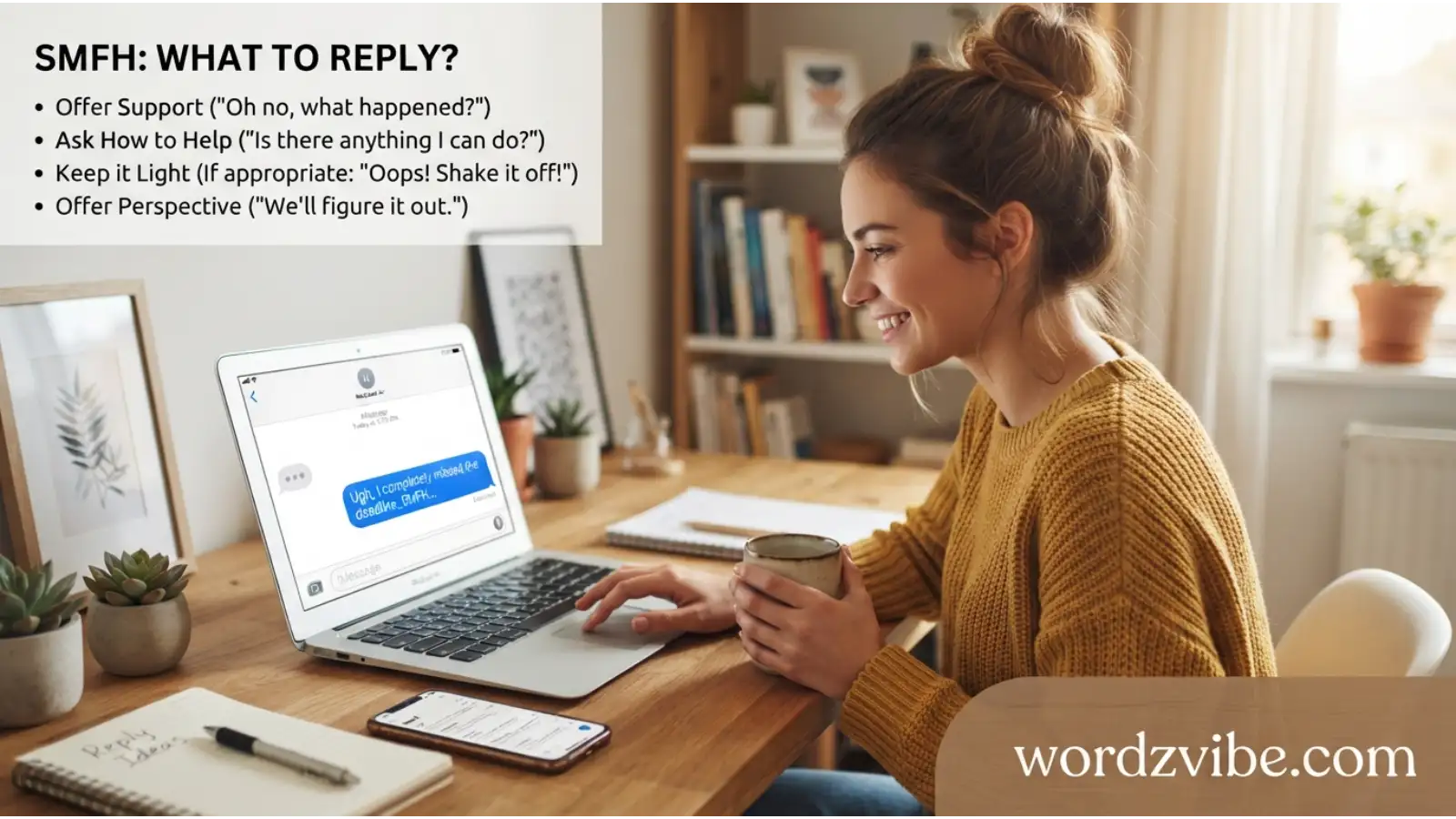
What Should You Reply to SMFH?
Your response depends on why the person sent it and how they intended it.
- Casual: “I know, right?”
- Funny: “Don’t judge me 😂”
- Understanding: “Yeah, that was frustrating.”
- Apologetic: “You’re right. I should have handled that better.”
- Clarifying: “Are you upset, or are you joking?”
If the sender is teasing you, a lighthearted reply may fit. If they seem genuinely upset, acknowledge the issue rather than responding with more sarcasm.
You do not need to mirror their language. A calm response can keep a frustrating conversation from becoming an argument.
Is SMFH Appropriate at Work?
SMFH is generally unsuitable for formal workplace communication because its full form contains profanity and may sound disrespectful.
In a private conversation with a close colleague, the abbreviation might be understood as casual slang. However, its use can still be risky in work chats, emails, or messages involving managers and clients.
Consider these alternatives:
- “I’m disappointed by this.”
- “That’s frustrating.”
- “I find this difficult to understand.”
- “I can’t believe this happened.”
These expressions communicate dissatisfaction without the same risk of offending someone.
Frequently Asked Questions
1. What does SMFH mean in text messages?
SMFH means “shaking my f***ing head.” People use it to express strong frustration, disappointment, disbelief, or disapproval in informal conversations.
2. Is SMFH stronger than SMH?
Yes, generally. SMFH adds profanity to the expression, making it more emphatic than SMH. Both abbreviations can communicate disappointment or disbelief, but SMFH often conveys greater frustration.
3. Does SMFH always mean someone is angry?
No. Someone may use SMFH to joke about a friend’s mistake or react sarcastically to an everyday inconvenience. The surrounding conversation helps reveal whether the sender is genuinely upset.
4. What is the difference between SMFH and SMDH?
SMFH stands for “shaking my f***ing head,” while SMDH stands for “shaking my damn head.” Both express frustration, disappointment, or disbelief, but they use different intensifiers.
5. Can I use SMFH in professional messages?
It is best to avoid SMFH in professional communication because it contains profanity and may sound disrespectful. Use expressions such as “That’s frustrating” or “I’m disappointed” instead.
Final Thoughts
SMFH means “shaking my f***ing head” and expresses a stronger reaction than SMH. People use it to show frustration, disbelief, disappointment, or playful annoyance in informal messages and online conversations.
When interpreting SMFH, consider the sender’s tone and the situation. If you use it yourself, remember that its profanity can make a message sound harsher than intended. A simpler expression may be more appropriate when communicating with colleagues, clients, or people you do not know well.

“My name is Ali Sarfraz, Senior Content Strategist & Author at WordzVibe.com. Holding a Master’s degree in English Linguistics with over 6 years of dedicated research in digital communication, I specialize in decoding viral internet slang, trending acronyms, and modern word meanings. Every term I define undergoes a multi-step fact-checking process to ensure absolute precision, linguistic accuracy, and trust for our readers.”
1 thought on “SMFH Meaning in Text: What It Means and How to Use It”