

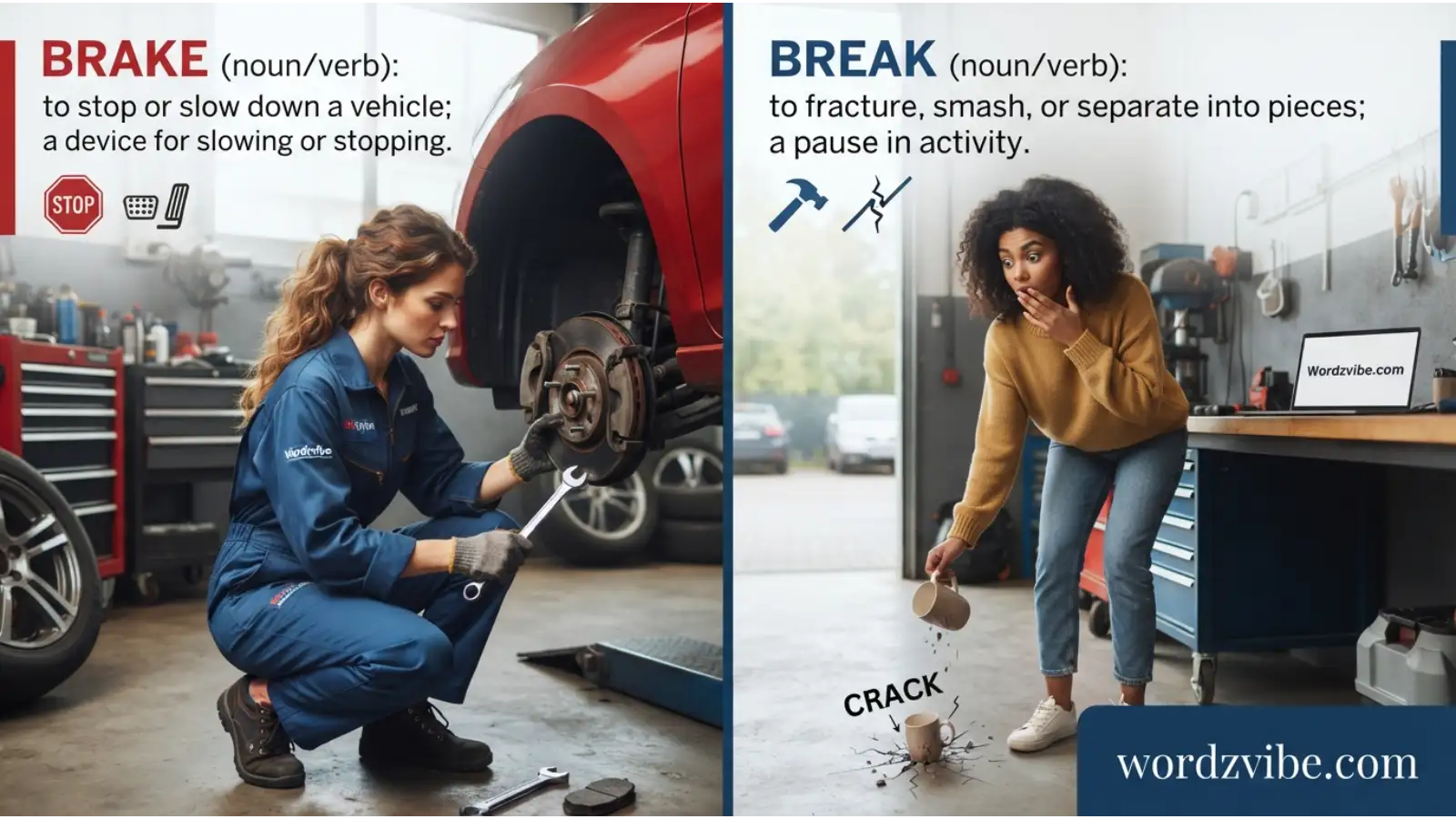
The words brake and break sound the same, but they have different meanings. This can make them confusing when writing emails, completing schoolwork, or sending everyday messages.
A brake helps slow down or stop a vehicle, while break can mean damaging something, interrupting an activity, or taking time to rest. For example, a driver applies the brakes at a red light, then takes a break after a long journey. Both spellings are correct, but they cannot be exchanged freely.
Understanding how each word works, including its past tense and common expressions, will help you choose the right one. The easiest way to tell them apart is to focus on the meaning of the sentence rather than how the words sound.
Quick Answer
Brake vs Break: Brake refers to a device or action used to slow down or stop a vehicle. Break means to damage, separate, interrupt, or pause something. For example, you press the brake to stop a car, but you take a break when you need to rest.
What Does Brake Mean?
Brake is a noun or verb associated with slowing down or stopping movement. It is most commonly used when talking about cars, bicycles, motorcycles, and other vehicles.
As a noun, a brake is the mechanism that helps control speed or stop movement. As a verb, brake describes using that mechanism to slow down or stop.
Examples include:
- Check the brakes before driving on a mountain road.
- She pressed the brake as the traffic light turned red.
- The cyclist braked before reaching the crossing.
- My car needs a brake inspection.
The word also appears in figurative expressions. For example, put the brakes on spending means to reduce or stop spending.
Remember: If the sentence involves slowing down or stopping movement, brake is usually the correct choice.
What Does Break Mean?
Break has several meanings. It can refer to damaging something, separating it into pieces, interrupting an activity, or taking time away from work.
Examples include:
- Be careful not to break the glass.
- I need a break after studying for two hours.
- They decided to break the chocolate into smaller pieces.
- He wants to break his habit of staying up late.
- The reporter was the first to break the news.
The meaning changes with the context. 1. In break a glass, the word refers to damage. In take a break, it means resting. In break the news, it means sharing important information.
Remember: If you are talking about rest, damage, interruption, or separation, break is generally the correct spelling.

Brake vs Break: Key Differences
The main difference is what each word describes. Although they sound identical, their meanings, spelling, and grammatical forms are different.
| Feature | Brake | Break |
|---|---|---|
| Main meaning | A device or action that slows or stops movement | Damage, separation, interruption, or rest |
| Part of speech | Noun and verb | Noun and verb |
| Present tense example | I brake before the turn. | I break the chocolate into pieces. |
| Past tense | Braked | Broke |
| Past participle | Braked | Broken |
| Common phrase | Apply the brakes | Take a break |
Both words are homophones, meaning they share the same pronunciation but have different spellings and meanings. The correct choice depends on what you want to communicate.
When Should You Use Brake?
Use brake when referring to a mechanism that controls movement or the action of slowing down or stopping.
As a noun, it identifies a part of a vehicle or machine. As a verb, it describes the action of using the braking system.
Consider these examples:
- The mechanic replaced the rear brake.
- Please brake gently on wet roads.
- He braked suddenly when a car pulled out in front of him.
- The emergency brake kept the parked vehicle from rolling.
The word can also describe slowing down an activity or process. For example, the company put the brakes on expansion means the company slowed or stopped its plans to grow.
When the sentence involves a vehicle’s braking system or the idea of slowing progress, brake is the appropriate spelling.
When Should You Use Break?
Use break when you mean to damage something, interrupt an activity, separate something into parts, or rest.
It also appears in many idioms and expressions, which makes it more flexible than brake in everyday English.
Examples:
- Don’t break your phone.
- We took a short break between classes.
- She hopes to break the school record.
- Please don’t break your promise.
- The children broke the cookies into smaller pieces.
The past tense is broke, while the past participle is broken. For example, you might say, “I broke my glasses yesterday,” or “My glasses are broken.”
Unlike brake, which usually relates to slowing or stopping movement, break has several meanings that depend on the surrounding words.
Brake vs Break in Everyday Sentences
Looking at both words in realistic situations makes the difference easier to understand.
| Sentence | Correct word | Reason |
|---|---|---|
| The driver pressed the ___ to stop. | Brake | It refers to stopping a vehicle. |
| I need a short ___ before work. | Break | It refers to resting. |
| Don’t ___ the new headphones. | Break | It refers to damaging an object. |
| You should ___ before the sharp turn. | Brake | It refers to slowing down. |
| Let’s take a lunch ___. | Break | It refers to a pause for a meal. |
| The cyclist ___ to avoid a pedestrian. | Braked | It is the past tense of the verb brake. |
A useful habit is to read the entire sentence before choosing a spelling. The surrounding words usually make the intended meaning clear.
Common Expressions With Brake and Break
Both words appear in everyday expressions, but each expression has its own meaning.
| Expression | Meaning |
|---|---|
| Hit the brakes | Slow down or stop a vehicle; figuratively, slow an activity |
| Emergency brake | A system used to help keep a vehicle stationary |
| Take a break | Stop an activity temporarily to rest |
| Break the ice | Help people feel more comfortable in a social situation |
| Break a promise | Fail to keep a promise |
| Coffee break | A short rest, often involving a drink |
| Break the news | Tell someone important information |
| Put the brakes on | Slow down or stop progress |
| Give me a break | Ask for understanding, relief, or a chance to rest |
These expressions are useful clues when deciding which spelling to use. For example, put the brakes on a project refers to slowing progress, while break the ice describes making a social interaction less awkward.
Is Brake or Break Correct in These Phrases?
Some phrases are easy to confuse because both words sound alike. The meaning of the expression determines the correct spelling.
- Take a break: Correct when you mean to rest or pause an activity.
- Apply the brakes: Correct when referring to a vehicle’s braking system.
- Break a glass: Correct when you mean to damage or shatter it.
- Brake suddenly: Correct when a driver slows down or stops quickly.
- Give me a break: Correct when asking for understanding, relief, or a pause.
- Break time: Correct when referring to a scheduled rest period.
- Brake failure: Correct when a vehicle’s braking system stops working properly.
One practical test is to replace the word with its intended meaning. If you mean slow down or stop a vehicle, choose brake. If you mean rest, damage, or interrupt, choose break.
What Are the Past Tense Forms of Brake and Break?
The past tense forms are different, so choosing the correct form matters as much as choosing the correct base word.
| Form | Brake | Break |
|---|---|---|
| Base form | Brake | Break |
| Third-person singular | Brakes | Breaks |
| Past tense | Braked | Broke |
| Past participle | Braked | Broken |
| Present participle | Braking | Breaking |
Examples:
- She braked before reaching the intersection.
- He broke his phone screen yesterday.
- The vehicle has braked several times on the descent.
- The window has broken, leaving glass on the floor.
- The driver is braking carefully.
A common mistake is writing breaked instead of broke. The verb break is irregular, so its past tense does not follow the usual pattern of adding -ed.
Why Are Brake and Break So Easy to Confuse?
Brake and break are homophones. In standard English pronunciation, they sound the same, even though their spellings and meanings differ.
This makes them easy to confuse when writing quickly, especially if you rely on how a word sounds instead of what it means.
For example, someone might write “I need to take a brake” because they hear the same sound in both words. The correct phrase is “I need to take a break.”
Spelling checkers may catch some mistakes, but they might not identify every incorrect choice when the word itself is spelled correctly. Reading the sentence for meaning is often the best way to spot the error.
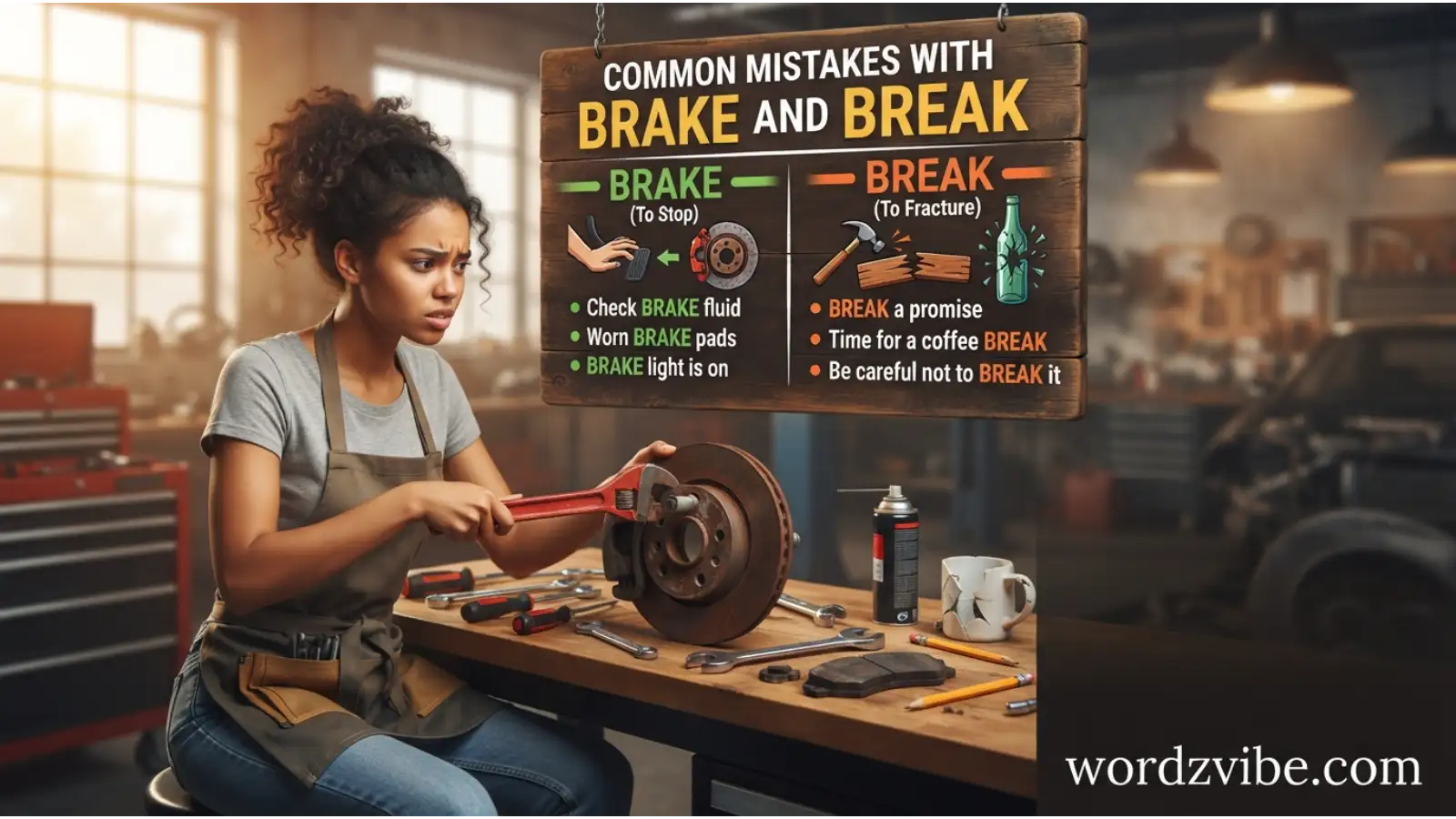
Common Mistakes With Brake and Break
Most mistakes happen when writers choose a word based on sound rather than meaning. These examples show how to correct the most common errors.
| Incorrect sentence | Correct sentence |
|---|---|
| I need to take a brake. | I need to take a break. |
| She pressed the break. | She pressed the brake. |
| He breaked the window. | He broke the window. |
| The car’s breaks need repair. | The car’s brakes need repair. |
| I broke before the corner. | I braked before the corner. |
Not every sentence containing break refers to physical damage, and not every use of brake involves a car. Figurative expressions such as break a habit and put the brakes on spending are also correct.
The key is to understand the intended action rather than memorizing spelling rules alone.
Brake vs Break: Which Word Is Correct in Formal Writing?
Both words are appropriate in formal writing when used correctly. Neither is inherently more professional or more informal than the other.
Use brake in technical reports, driving instructions, vehicle maintenance documents, and other contexts involving braking systems. Use break when discussing interruptions, damage, rest periods, or expressions such as break a contract.
For example:
- Formal: The technician inspected the vehicle’s braking system.
- Formal: Employees are entitled to a scheduled rest break under the applicable policy.
- Informal: I’ll take a quick break and call you back.
In professional communication, accuracy matters more than choosing one word over the other. Make sure the spelling matches the intended meaning.
Frequently Asked Questions
1. What is the difference between brake and break?
A brake is a device or action used to slow down or stop movement. Break can mean to damage something, separate it, interrupt an activity, or take a rest. Both words sound the same but have different meanings.
2. Are brake and break pronounced the same?
Yes. They are homophones in standard English, meaning they have the same pronunciation but different spellings and meanings. You usually need the context of the sentence to determine which word is correct.
3. Is it take a brake or take a break?
The correct phrase is take a break when you mean to rest or pause an activity. For example, “I’m going to take a break after lunch.” The word brake is associated with slowing or stopping movement.
4. Is it break the car or brake the car?
Both expressions can be grammatically correct, but they communicate different ideas. Break the car usually means to damage it or cause it to stop functioning. Brake the car means to slow it down or stop it using the braking system.
5. What are the past tense forms of brake and break?
The past tense of brake is braked. The past tense of break is broke, and its past participle is broken. For example, “She braked suddenly” and “He broke his glasses.”
Final Thoughts
Understanding Brake vs Break: Meaning, Usage, and Examples becomes much easier when you focus on what each word describes. Use brake when referring to slowing down or stopping movement, especially in a vehicle. Use break for resting, damaging something, separating it, or interrupting an activity.
Remember the phrases apply the brakes and take a break. They offer a simple way to keep the two spellings straight. When you are unsure, read the full sentence and identify its intended meaning before choosing a word. This small habit can improve spelling accuracy in schoolwork, emails, professional documents, and everyday conversations.

My name is Muhammad Waseem, author at WordzVibe.com. With a Master’s degree in English and over 6 years of linguistic experience, I break down modern digital terms, viral slang, and word meanings into simple language. Every definition on this site is personally researched, written, and verified by me to ensure full accuracy and reliability.
1 thought on “Brake vs Break: Meaning, Usage, and Examples”