

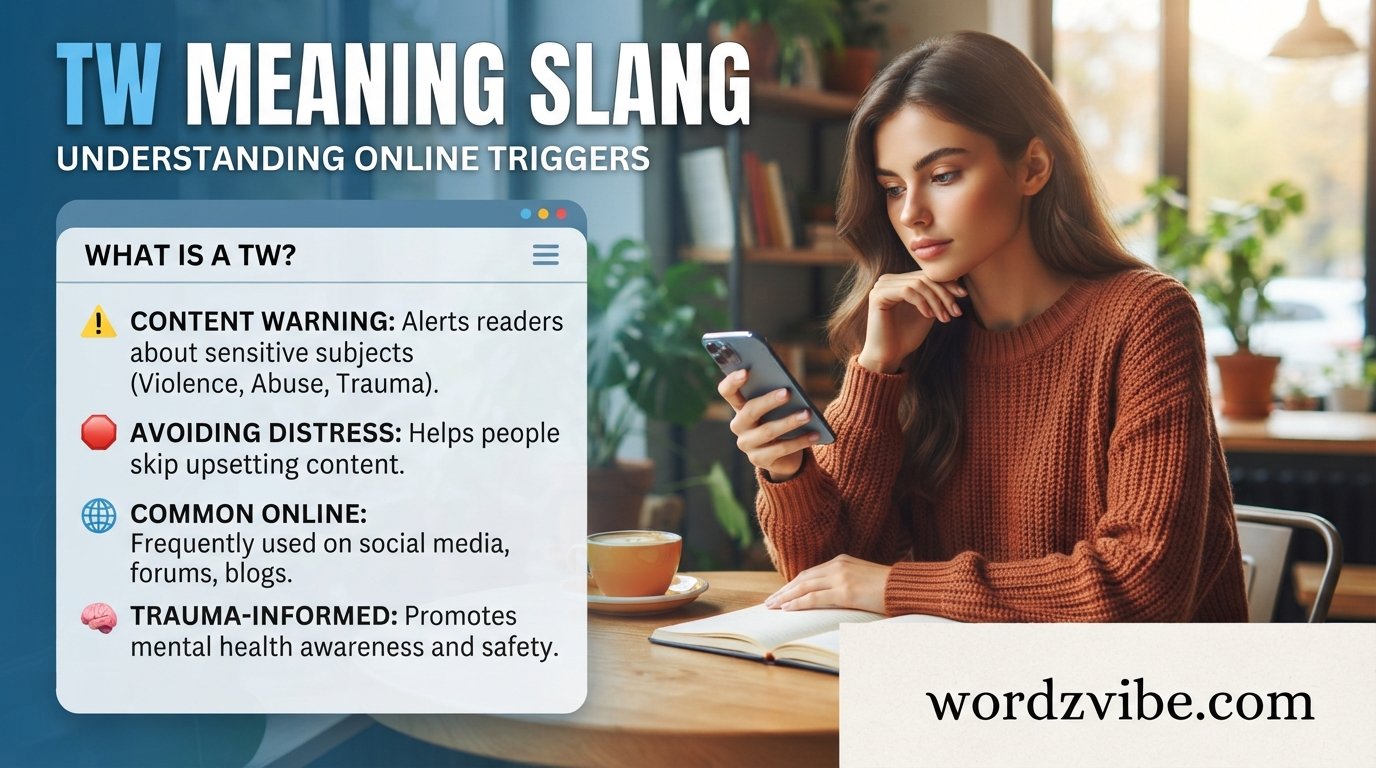
Have you seen TW before a post, video, or message and wondered what the letters mean? In online conversations, TW most commonly stands for “trigger warning.”
It alerts readers that the following content may discuss something upsetting, such as abuse, violence, grief, or another sensitive subject.
The TW meaning slang can depend on context, though. On social media, it often appears before a caption or video, while in a private chat, someone may use it to prepare a friend for a difficult topic.
TW can also have other meanings in specific settings, including abbreviations related to countries or personal information. Looking at the words around it usually helps you understand the intended meaning.
Quick Answer
TW means “trigger warning” in most online conversations involving sensitive content. People use it before a message, image, story, or video that may be distressing to some readers. The abbreviation is generally considerate rather than rude, but its meaning can change in other contexts.

What Does TW Mean in Chat?
In chat, TW usually warns someone that the next message contains a sensitive subject. It gives the other person a chance to decide if they want to continue reading.
Example:
- Person A: “TW: This story mentions a serious accident.”
- Person B: “Thanks for letting me know.”
Here, TW prepares the reader for potentially upsetting details. It does not mean the sender is upset with the person receiving the message.
Someone might also write “TW: grief” before sharing a personal experience about losing a loved one. The warning can be brief; it does not need a long explanation.
What Does TW Stand For?
TW stands for trigger warning in this common online use. A trigger warning is a short notice placed before content that could cause distress, particularly for people with related traumatic experiences.
For example, a post discussing domestic abuse might begin with “TW: domestic abuse.” This lets readers know the subject before they decide whether to read the full post.
A warning does not mean everyone will react in the same way. It simply gives people information that may help them make a personal choice.
TW Meaning in Gen Z Slang
When Gen Z users write TW online, they may be using it as a quick way to flag sensitive material. However, TW is not exclusive to Gen Z, and it is better understood as an online abbreviation than as a slang term belonging to one generation.
For example:
“TW: panic attacks — sharing something that helped me.”
The writer is signaling that the post discusses panic attacks before readers open or continue reading it.
The meaning is usually straightforward when TW appears before a sensitive subject. Do not assume that every use of the letters reflects a particular age group or internet trend.
TW Meaning on Instagram
On Instagram, TW can appear in captions, Stories, Reels, or text slides before a post discusses a sensitive subject. The goal is to give viewers an idea of what they may see or read.
Example: “TW: graphic injury in the next slide.”
This tells followers that the next part of the post contains potentially disturbing material. Some creators place the warning on a separate opening slide so viewers can stop before seeing the content.
TW is not a special Instagram-only abbreviation. It generally carries the same meaning it has in other online spaces.

TW Meaning on TikTok and Social Media
On TikTok and other social platforms, TW commonly means “trigger warning” when it appears before sensitive content. It may be written in a video caption, shown as on-screen text, or included in a comment.
For example, a creator might write “TW: discussion of eating disorders” before sharing an educational video. The warning helps viewers decide whether they want to watch.
The abbreviation does not have a separate, universal TikTok meaning. If it appears in a username, a technical discussion, or a conversation unrelated to sensitive topics, consider the context before interpreting it.
TW Meaning in Gender Contexts
When TW appears in a conversation about gender, its meaning may differ from “trigger warning.” In some transgender-related discussions, TW can stand for “trans woman,” referring to a transgender woman.
For example, someone discussing representation in a film review might use TW as shorthand for trans woman. This usage depends on the community and the surrounding conversation.
Because the same letters can have more than one meaning, do not automatically interpret TW as “trigger warning” when the topic is gender identity. Read the full sentence to determine which meaning fits.
TW Meaning in Country Codes
In country-related contexts, TW is the two-letter country or territory code commonly used for Taiwan in standards and online systems. For instance, the internet country-code top-level domain .tw is associated with Taiwan.
This meaning is different from the texting abbreviation “trigger warning.” If you see TW beside a country name, website address, location field, or technical listing, the geographical meaning is more likely.
The setting is the key clue: a sensitive-content notice usually points to “trigger warning,” while a country-code list may point to Taiwan.

TW vs. CW: What Is the Difference?
- TW and CW are both used to warn people about potentially sensitive material, but some writers distinguish between them.
| Term | Meaning | Typical use |
|---|---|---|
| TW | Trigger warning | Flags content that may cause distress, especially when connected to trauma |
| CW | Content warning | Signals potentially sensitive, disturbing, or uncomfortable material more broadly |
People sometimes use these terms interchangeably. Others prefer CW for general warnings and TW when a subject may be particularly triggering. There is no single rule followed by every online community.
Is TW Rude or Offensive?
TW is not inherently rude or offensive. When used as a warning, it is generally intended to help readers prepare for sensitive content.
For example, “TW: discussion of grief” is a neutral notice. However, someone could use the abbreviation sarcastically to mock another person’s feelings, making the surrounding message insensitive.
The abbreviation itself is not the problem; the way someone uses it determines the tone.
How Should You Reply to TW?
You do not need to respond to TW itself, but you can acknowledge the warning if someone sends it directly to you.
Here are a few natural replies:
- Casual: “Thanks for the heads-up.”
- Friendly: “I appreciate the warning.”
- Supportive: “Thanks for being considerate.”
- If you want to skip the content: “Thanks for letting me know. I’ll pass on this one.”
Choose a reply that feels natural for the conversation. You are not required to explain why you prefer not to read or watch something.
Frequently Asked Questions
1. What is the TW meaning slang in text?
TW usually means “trigger warning” when it appears before sensitive content in a text message. It alerts the recipient that the next part may discuss an upsetting subject.
2. Does TW mean the same thing on every platform?
No, although “trigger warning” is a common meaning on social media and in chats. In gender-related conversations, TW may mean “trans woman,” while country-code contexts may refer to Taiwan.
3. What does TW mean in Urban Dictionary?
User-submitted slang dictionaries may include different interpretations of TW, but the intended meaning depends on the entry and its context. For a message warning about sensitive material, “trigger warning” is the most likely interpretation.
4. Is TW a Gen Z term?
TW is used in online communication by people of different ages, so it is not limited to Gen Z. Its use as shorthand for “trigger warning” is tied to the context rather than a specific generation.
5. Should I skip a post with a TW label?
You can decide based on the topic and your comfort level. The label gives you advance notice so you can continue, take a break, or skip the content.
Final Thoughts
The most common TW meaning slang is “trigger warning,” a notice used before content that may be emotionally difficult or upsetting. It is generally meant to help people make an informed choice, not to insult them.
Still, TW can have other meanings in gender discussions, country codes, and specialized conversations. Check the words around it before deciding what someone means.

My name is Muhammad Waseem, author at WordzVibe. With a Master’s degree in English and over 6 years of linguistic experience, I break down modern digital terms, viral slang, and word meanings into simple language. Every definition on this site is personally researched, written, and verified by me to ensure full accuracy and reliability.