

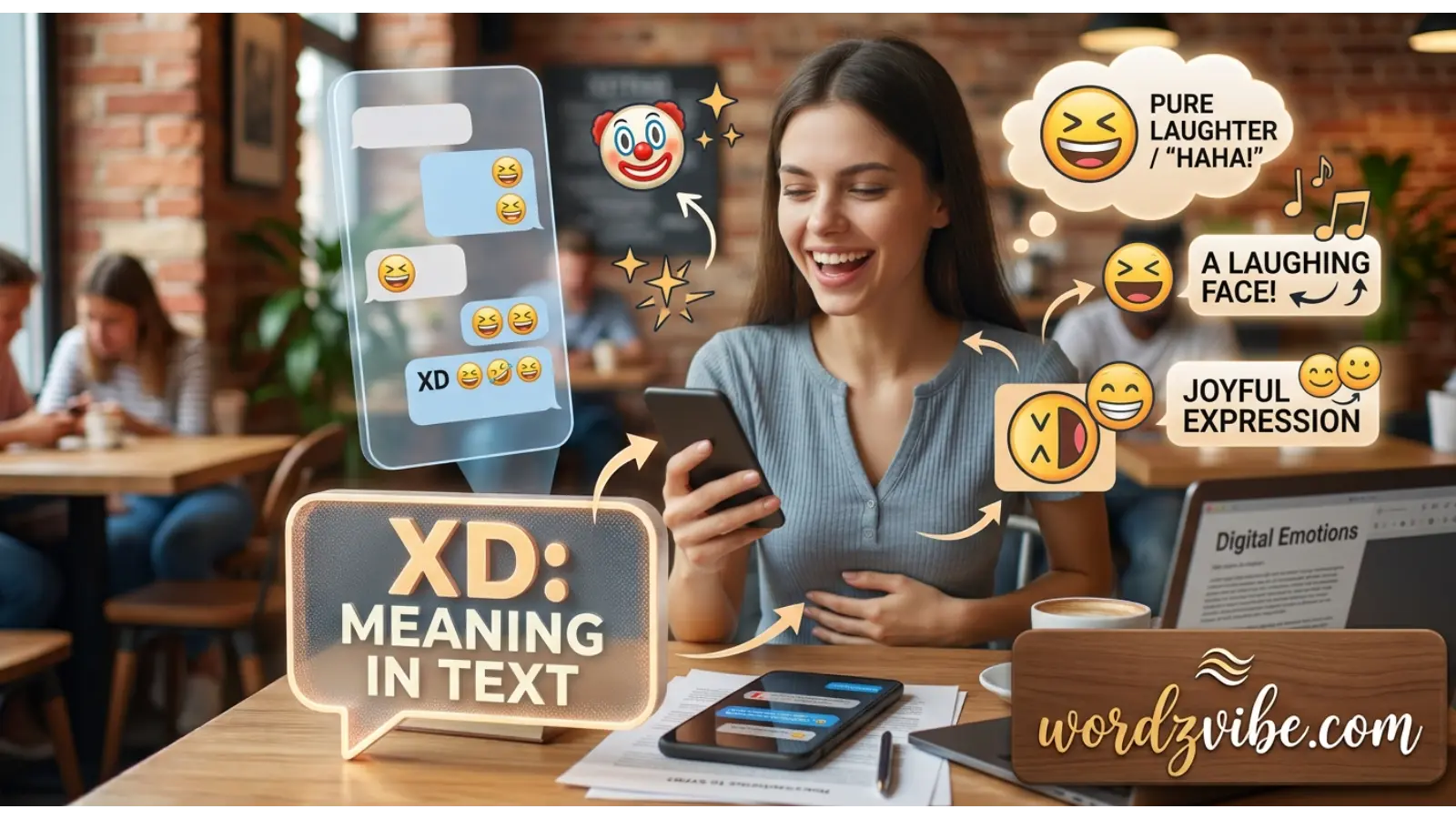
I often see xd meaning in text searched by people who receive a message containing XD and are not sure what the sender really means. From my experience with online language, XD is a text expression used to show strong laughter, amusement, or a funny reaction.
I usually read it as a visual laughing face, where the X represents tightly closed eyes and the D represents a wide, open laughing mouth.
When I explain xd meaning in text, I also point out that the exact feeling depends on the conversation. I might use XD when something genuinely makes me laugh, while another person may use it casually after a funny comment.
That is why I think understanding the tone behind XD matters just as much as knowing its basic definition. In this guide, I will explain what XD means, where it came from, how I use it in real conversations, when it fits, and when I would avoid it.
Quick Answer
- I use XD as a text based expression for laughter, amusement, or finding something very funny.
- I see the X as closed laughing eyes and the D as a wide open laughing mouth.
- I normally use XD in casual conversations, texts, social media, gaming chats, and friendly messages.
What Does XD Mean in Text?
When I explain xd meaning in text, I define XD as an emoticon that represents laughter or a strong amused reaction. I usually see it when someone wants to show that they found a message, joke, picture, or situation funny.
For me, XD has a more expressive feeling than simply writing lol. The capital letters make the face easier to recognize, although many people also write it as xd or xD.
I commonly see XD used in places such as:
- Text messages between friends.
- Social media comments.
- Online gaming chats.
- Group conversations.
- Casual direct messages.
- Memes and humorous posts.
The emotional strength can change from person to person. I might use XD for genuine laughter, while someone else may use it simply to keep a conversation playful.
I also consider the surrounding words before interpreting it. For example, a message such as That was hilarious XD clearly shows amusement, while XD after a small mistake may simply make the situation feel less serious.
XD Meaning in Text and Its Origin
When I look at the history behind xd meaning in text, I connect it with the long tradition of emoticons used to communicate emotion through plain keyboard characters. People began creating sideways facial expressions with letters and punctuation before modern emoji became common.
I understand XD as a visual face rather than a traditional abbreviation. When I turn my head sideways and look at it, the X can resemble tightly shut eyes and the D can resemble a large open mouth during laughter.
The expression became especially popular through internet forums, instant messaging, gaming communities, and other online spaces. I have seen it associated with the informal internet language that developed as people looked for quick ways to express emotion in text.
I would not treat XD as a formal English word or standard professional abbreviation. Instead, I see it as an internet emoticon whose meaning comes from its visual appearance and common online use.
How I Use XD in Real Conversations
I normally use XD when I want my message to sound playful, relaxed, or humorous. For me, it works best when the people involved already understand informal online communication.
Here are some natural examples I might use:
- I just spilled coffee everywhere XD.
- You really thought that would work XD.
- That movie ending was crazy XD.
- You actually sent that message to the wrong person XD.
- I cannot stop laughing at this XD.
I usually place XD at the end of a sentence, but I can also use it as a standalone reaction. If a friend sends me something hilarious, simply replying XD can communicate that I found it funny.
I also pay attention to the relationship between the speakers. With close friends, XD can feel completely natural, while using it with someone unfamiliar may make my message appear overly casual.

What Emotional Tone Does XD Carry?
I see XD as mainly positive and humorous, but its exact tone can change with context. The same expression can communicate genuine laughter, playful teasing, embarrassment, or even mild sarcasm.
For example, I might write I cannot believe you did that XD when I am teasing a friend. In that situation, the expression softens the statement and makes it clear that I am not seriously criticizing them.
I also notice that repeated use can make XD feel less intense. Someone who adds XD to almost every message may not literally be laughing each time.
I usually interpret the tone by considering:
- The words around XD.
- The relationship between the speakers.
- The subject of the conversation.
- The number of times XD appears.
- The overall mood of the chat.
For me, context is the key. I would not automatically assume that every XD means someone is laughing loudly.
XD vs LOL vs LMAO
When I compare common internet expressions, I see important differences in tone and style.
| Expression | Definition | Tone | Best Use Case | Key Difference |
|---|---|---|---|---|
| XD | Laughing or amused reaction | Playful | Casual chats | Looks like a laughing face |
| LOL | Laughing out loud | Casual | Texts and social media | Common and widely understood |
| LMAO | Strong laughter | Very casual | Friends and informal chats | Usually stronger than LOL |
| Haha | Written laughter | Natural and flexible | Most casual conversations | Feels like ordinary written laughter |
I generally find XD more visual than LOL. Instead of describing laughter with words, I am using characters to create the appearance of a laughing face.
I would also be more careful with LMAO because it is more informal and contains profanity based on its expanded form. For a broad audience, I usually consider XD and LOL easier choices.
Can I Use XD in Professional Communication?
I would avoid XD in formal workplace communication unless I already know the company culture allows very casual messaging. In a professional email, I would normally choose clear words instead of an internet emoticon.
For example, I would not recommend writing:
Thank you for fixing that mistake XD.
Instead, I would write something like:
Thank you for fixing that issue. I appreciate your help.
In a casual workplace chat with a close colleague, however, I might use XD if the environment is clearly informal. Even then, I would consider the person, topic, and communication channel before sending it.
I especially avoid XD in academic papers, official letters, job applications, formal reports, and important business emails. My editorial rule is simple: when professionalism matters, I choose precise language over internet slang.
Common Mistakes I See With XD
I often notice people misunderstand XD because they treat it like a fixed abbreviation with only one emotional meaning. I think this approach misses the role of context in digital communication.
Some common mistakes include:
- Assuming XD always means intense laughter.
- Using XD in formal documents.
- Thinking XD has one exact emotional strength.
- Confusing XD with a professional abbreviation.
- Using it repeatedly until the message becomes difficult to read.
I also recommend avoiding XD when the recipient may not understand internet expressions. If I am communicating with someone unfamiliar with texting culture, I prefer a simple phrase such as That is funny.
Another mistake is assuming capitalization changes the basic meaning completely. I generally see XD, xD, and xd as variations of the same basic emoticon, although individual users may attach slightly different tones to them.
When Should I Use XD?
I use XD when I want to add a clear playful or humorous feeling to a casual message. It works especially well when I am talking with friends, gaming partners, online communities, or people who regularly use internet slang.
I find these situations suitable:
- Reacting to a funny joke.
- Responding to a silly mistake.
- Teasing a friend.
- Commenting on a funny meme.
- Reacting to an unexpected situation.
- Keeping an informal conversation light.
I would think twice before using it with a teacher, employer, customer, client, interviewer, or someone I have never spoken to before.
For me, the safest rule is to match the communication style of the other person. If they regularly use casual emoticons, XD will probably feel natural. If their messages are formal and serious, I would leave it out.
People Also Ask About XD Meaning in Text
What does XD mean in text?
I use XD as an emoticon that shows laughter, amusement, or a playful reaction. It visually resembles a face laughing with closed eyes and an open mouth.
Is XD a bad word?
No. I do not consider XD a bad word. I see it as an informal internet expression used mainly to show amusement.
What does xD mean from a girl?
I would not assign a special meaning to xD based only on the sender being a girl. I interpret it according to the conversation, relationship, and surrounding words.
Is XD still used in texting?
Yes. I still see XD in casual texting, gaming, social media, and online conversations, although many people now prefer modern emojis.
Is XD the same as LOL?
I consider them similar because both can express laughter. However, XD is a visual emoticon, while LOL is an abbreviation for laughing out loud.
Final Thoughts
When I explain xd meaning in text, I keep the core idea simple: XD is an informal emoticon that I use to show laughter, amusement, or a playful reaction. Its exact emotional strength can change depending on the person and the conversation.
I believe context should always guide the way we understand internet language. I can use XD naturally with friends, but I would choose more professional wording in formal communication. Once we understand that difference, expressions like XD become much easier to read and use correctly.

My name is Muhammad Waseem, author at WordzVibe.com. With a Master’s degree in English and over 6 years of linguistic experience, I break down modern digital terms, viral slang, and word meanings into simple language. Every definition on this site is personally researched, written, and verified by me to ensure full accuracy and reliability.