

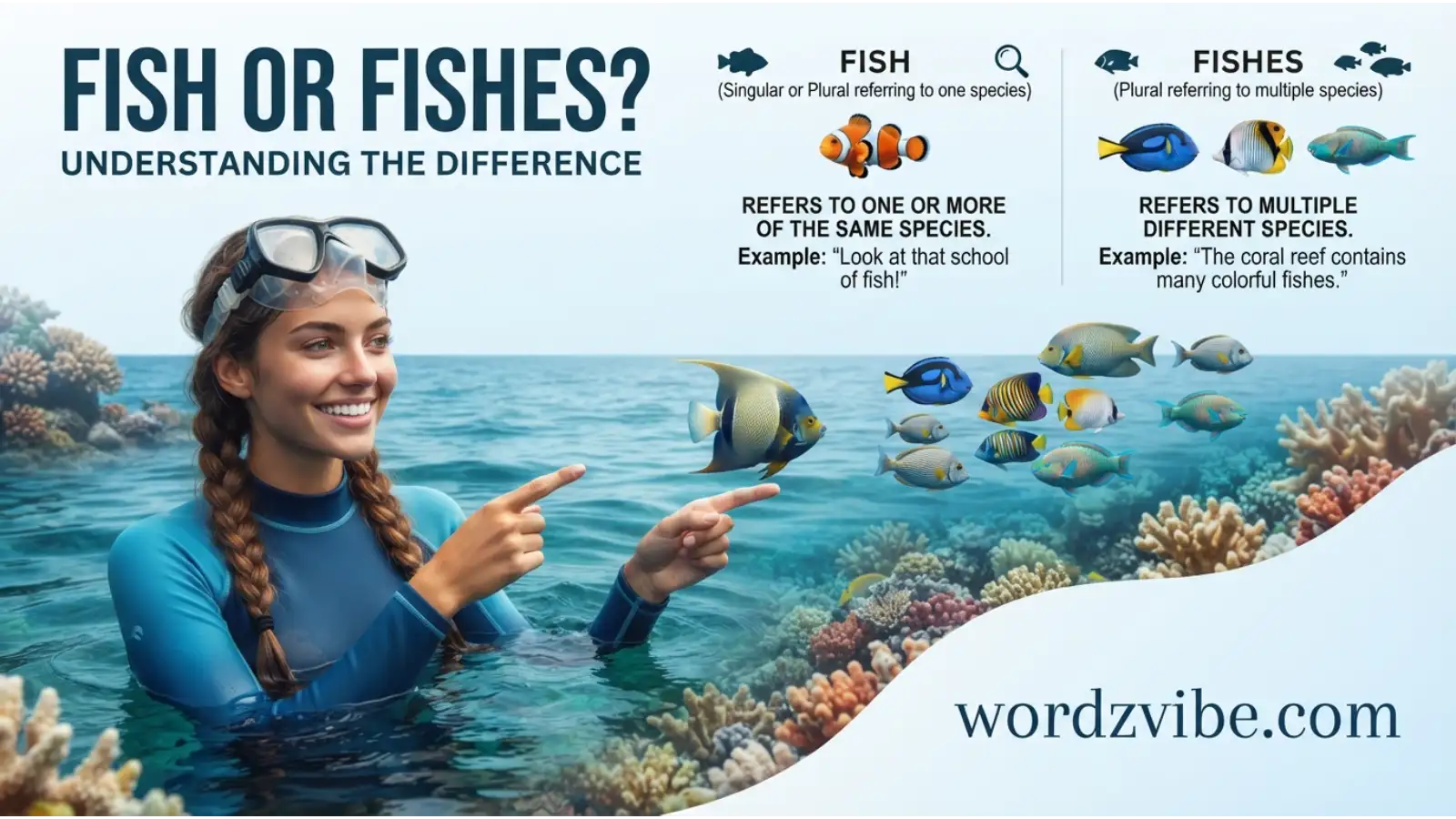
The words fish and fishes can both be correct, but they are not always used in the same way. For most everyday situations, fish is the usual plural form when talking about more than one fish, especially when the species does not matter.
Fishes has a more specific use. It is generally used when referring to different species, varieties, or groups of fish, particularly in scientific, biological, or technical writing. Knowing the difference can help you choose the form that sounds natural and fits the context.
Quick Answer
Fish is normally used as both the singular and plural form: “I caught one fish” and “I caught three fish.” Fishes is also a valid plural form, but it usually refers to different species or types of fish. In ordinary conversation, fish is the much more common choice.

Is Fish Singular or Plural?
Fish can be either singular or plural.
When referring to one animal, you can say:
- I saw a fish in the pond.
- She caught a fish.
- That fish is colorful.
When referring to more than one, the word can stay unchanged:
- I saw three fish in the pond.
- We caught several fish.
- There are many fish in the aquarium.
The surrounding words usually tell the reader whether fish refers to one animal or several.
When Do You Use Fish as the Plural?
Use fish as the plural when you are simply talking about multiple fish without focusing on their different species.
For example:
- There are five fish in the tank.
- We watched the fish swimming together.
- The fisherman caught several fish.
- My children love feeding the fish.
This is the normal choice in everyday English.
You do not normally need to add -es simply because there is more than one fish.
One fish: I saw one fish.
Several fish: I saw several fish.
Both are grammatically correct.
When Do You Use Fishes?
Fishes is used when the focus is on different species, varieties, or types of fish.
For example:
The aquarium contains many fishes from different parts of the world.
The focus here is not simply on the number of animals. It is on the different kinds represented.
Another example is:
Scientists studied the fishes living in these separate habitats.
In this context, fishes can refer to different species or groups being examined.
You are more likely to encounter this form in biology, ecology, marine science, and other specialized writing than in casual conversation.
Fish vs. Fishes: The Main Difference
The easiest way to remember the distinction is this:
| Term | Typical use | Example |
|---|---|---|
| Fish | Multiple fish generally | There are many fish in the lake. |
| Fishes | Different species or types | The study examines several fishes. |
The important point is that fishes does not simply mean “more than one fish.” In most situations, fish already serves as the plural.
Is Fishes Grammatically Correct?
Yes. Fishes is grammatically correct, but it has a more specific use than the everyday plural fish.
Consider these two sentences:
The pond has many fish.
This simply tells us that many individual fish are in the pond.
The research compares fishes from several regions.
Here, the wording places more attention on groups or types of fish from different regions.
So, fishes is not automatically wrong. It is simply less common in ordinary speech and writing.
Why Do People Usually Say Fish Instead of Fishes?
English has several animal nouns whose singular and plural forms can be identical.
For example:
- one sheep → two sheep
- one deer → two deer
- one fish → two fish
Because fish already works naturally as a plural noun, speakers generally do not need fishes when simply talking about several fish.
Compare:
I saw ten fish at the aquarium.
This sounds completely natural.
I saw ten fishes at the aquarium.
The second sentence may sound unusual unless the context is specifically about different species or biological groups.
Can Fishes Refer to Individual Fish?
Yes, but context matters.
Fishes can refer collectively to individual fish when the discussion focuses on species, groups, habitats, or biological classification.
For example:
Researchers examined fishes collected from several coastal environments.
The emphasis is on the fish being studied as part of different biological groups.
If you are simply counting individual animals, however, fish is normally the better choice:
Researchers collected twenty fish.
That sentence is natural and does not need fishes.
Fish or Fishes in Scientific Writing
You are more likely to see fishes in scientific and academic writing, especially when researchers are discussing multiple species.
For example:
The study examines the fishes found in tropical coral reefs.
Here, the writer may be referring to a range of species.
However, scientists do not always use fishes. Fish is still perfectly acceptable when referring generally to individual animals or fish as a broad group.
For example:
Fish are important members of aquatic ecosystems.
There is no need for fishes because the sentence is discussing fish generally.
What About Different Species?
The distinction becomes especially useful when several species are involved.
Imagine an aquarium containing goldfish, angelfish, and clownfish.
You could say:
The aquarium has many fish.
This is a general statement about the animals.
You could also say:
The aquarium contains several fishes from different regions.
Here, fishes emphasizes the variety of species.
For everyday readers, however, a clearer alternative may be:
The aquarium contains several species of fish.
This wording makes the intended meaning immediately obvious.
Is Fish or Fishes More Common?
Fish is much more common in everyday English.
People normally say:
- I like fish.
- We saw some fish.
- How many fish did you catch?
- There are colorful fish in the tank.
Fishes appears less frequently and is more strongly associated with scientific, biological, ecological, or technical contexts.
If you are unsure which form to choose, fish is usually the safest and most natural option.
What Is the Plural of Fish When Talking About Food?
When discussing fish as food, fish is normally used.
For example:
We had fish for dinner.
You would not normally say:
We had fishes for dinner.
The word fish here refers to the food in a general sense.
You can also use fish for individual animals prepared as food:
The restaurant served three whole fish.
Here, fish refers to three individual fish.
What About Different Kinds of Fish?
When you want to make the distinction especially clear, phrases such as types of fish, kinds of fish, or species of fish are often more natural than fishes.
For example:
The lake contains several species of fish.
Or:
We studied different types of fish.
These expressions are particularly useful when writing for a general audience because they remove possible ambiguity.
Fish or Fishes for Animals in an Aquarium?
For ordinary descriptions of aquarium animals, fish is usually the natural choice.
For example:
There are twenty fish in the aquarium.
If the aquarium contains several species and you specifically want to emphasize that diversity, you could use:
The aquarium contains fishes from several regions.
Still, different species of fish may be clearer in general-purpose writing.
Fish or Fishes When Talking About a School?
A group of fish is often called a school of fish.
For example:
We saw a large school of fish near the reef.
Even though the group contains many individual animals, fish remains the natural plural form.
You would generally not say:
We saw a large school of fishes.
The plural fish is the standard choice when describing the group generally.
Fish vs. Fishes in Everyday English
For most everyday situations, choose fish.
Use fish when:
- Counting individual fish
- Talking about fish generally
- Discussing fish as food
- Describing aquarium animals
- Talking about fish in a lake, river, or ocean
- Speaking or writing casually
Use fishes when the context specifically focuses on different species, varieties, groups, or biological classifications.
The distinction is small, but it can make your English more precise.
Fish vs. Fishes in Formal Writing
Formal writing does not automatically require fishes.
The correct choice still depends on what you mean.
For example:
The researchers studied fish in the river.
This is perfectly appropriate formal English.
If the research specifically compares multiple species, you might see:
The researchers compared fishes from three different habitats.
So, do not assume that fishes sounds more educated or formal. It should be used because of its meaning, not simply because the writing is academic.
Common Mistake: Adding Fishes Automatically
One common mistake is assuming that fishes must be used whenever there is more than one fish.
For example:
I caught three fishes.
This can be grammatically possible in a particular context, but if you simply mean three individual fish, the natural sentence is:
I caught three fish.
The better rule is simple: do not use fishes merely because the noun is plural.
Use fishes when the context gives you a specific reason to emphasize different species or groups.
Common Mistakes With Fish and Fishes
A few misunderstandings appear repeatedly.
First, some people believe fish is always singular. It is not. Fish can be singular or plural.
Second, some people think fishes is incorrect. It is not. It is a valid plural form with a more specialized use.
Third, some writers use fishes whenever they want to sound formal. That is unnecessary. The meaning should determine the choice.
Finally, people sometimes assume that every collection of different fish must be called fishes. In many situations, different species of fish is clearer and more natural.

Fish or Fishes: Which One Should You Use?
If you are writing a normal sentence and simply mean more than one fish, choose fish.
For example:
There are many fish in this river.
If you are specifically discussing different species or biological groups, fishes may be appropriate:
The researchers documented several fishes in the region.
When writing for a general audience, you can often make the meaning even clearer by saying different species of fish.
Related Terms You May See
Understanding fish and fishes also helps with related expressions.
Fish species refers to distinct biological species.
Types of fish is a general expression for different kinds of fish.
School of fish describes a group of fish swimming together.
Fishery refers to an industry, place, or activity involving catching, managing, or raising fish.
Fishing refers to the activity of catching fish.
These terms have their own meanings, so they should not be treated as interchangeable with fish or fishes.
Frequently Asked Questions
1. Is fish the plural of fish?
Yes. Fish can be both singular and plural. You can say “one fish” and “five fish.” This is the normal plural form in most everyday situations.
2. Is fishes a correct plural of fish?
Yes. Fishes is a correct plural form, but it is generally used when referring to different species, varieties, or groups of fish, particularly in scientific or technical contexts.
3. Should I say “two fish” or “two fishes”?
In normal conversation, say two fish. Two fishes may be appropriate when the context specifically concerns different species or types rather than simply two individual animals.
4. What is the difference between fish and fishes?
Fish is the usual plural for multiple individual fish. Fishes generally emphasizes different species, varieties, or biological groups.
5. Which is more natural: fish or fishes?
Fish is much more natural for everyday English. If you are simply talking about more than one fish, use fish. Choose fishes when a scientific or species-based distinction is important.
Final Thoughts
Fish is normally the plural form you want in everyday English, while fishes has a more specialized use. If you are simply talking about several individual fish, fish is the natural choice. When discussing different species or biological groups, fishes can be appropriate.
The easiest rule to remember is: use fish for general plural use and fishes when the focus is on different species or kinds.

My name is Muhammad Waseem, author at WordzVibe.com. With a Master’s degree in English and over 6 years of linguistic experience, I break down modern digital terms, viral slang, and word meanings into simple language. Every definition on this site is personally researched, written, and verified by me to ensure full accuracy and reliability.
1 thought on “Fish or Fishes: Understanding the Difference”