

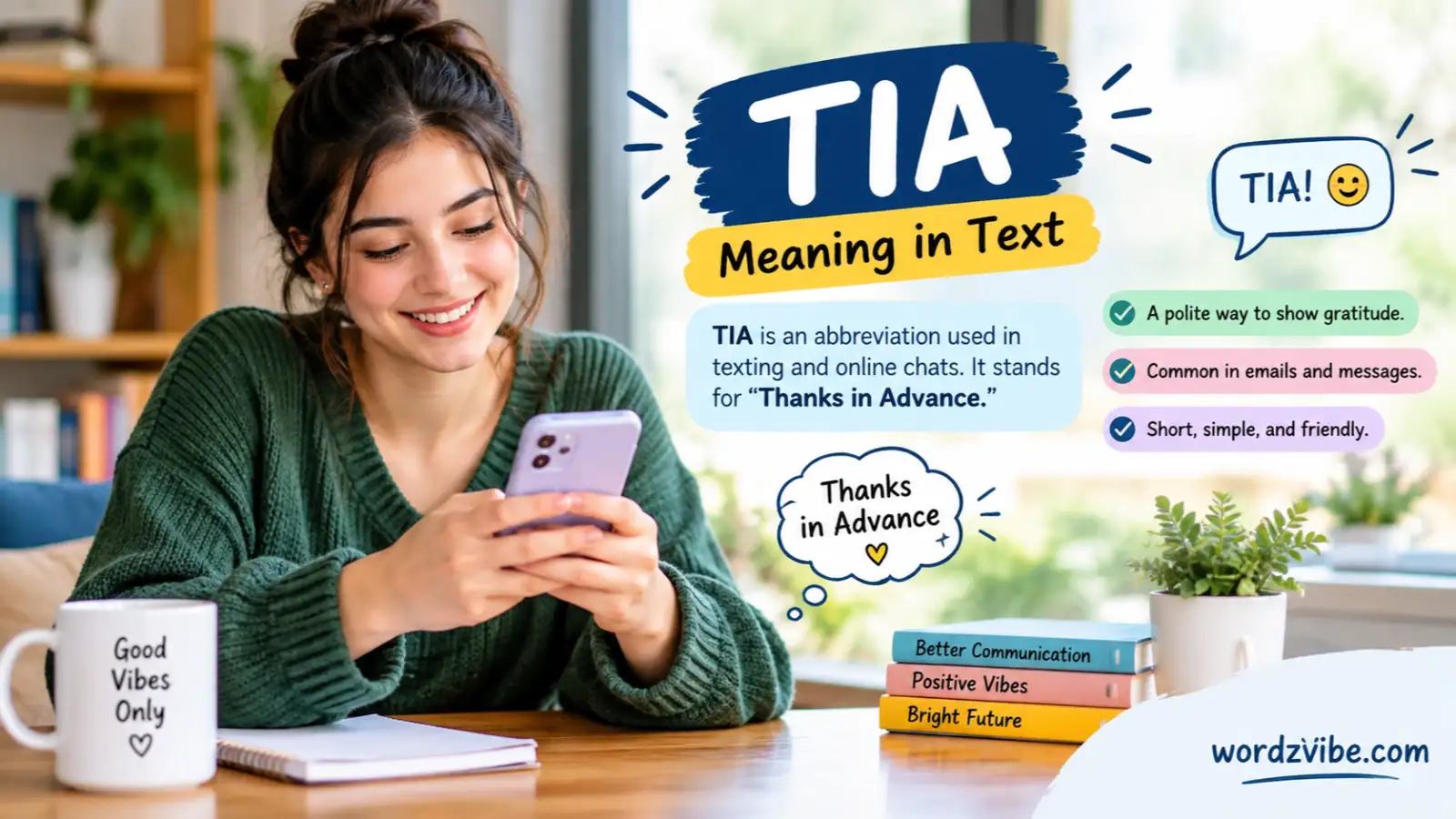
If you see TIA at the end of a text, Facebook post, or online question, the most common meaning is “Thanks in advance.” People use it after asking for help, advice, information, or a recommendation. It is a convenient abbreviation that lets someone show appreciation before the other person responds.
However, TIA does not always mean “Thanks in advance.” Depending on the context, it can refer to a medical term, the Spanish word tía, or another meaning entirely. Understanding the situation around the abbreviation is the easiest way to know which meaning applies.
Quick Answer
TIA meaning in text is usually “Thanks in advance.” It is an informal abbreviation used after a request to thank someone before they provide help. For example, “Does anyone know a good restaurant nearby? TIA.” In medical contexts, however, TIA means transient ischemic attack, which is a completely different meaning.
What Does TIA Mean in Text?
In texting, TIA usually stands for “Thanks in advance.”
People commonly place it at the end of a question or request. It shows that they appreciate the reader’s help before receiving a response.
For example:
“Can anyone tell me how to reset this phone? TIA.”
This means:
“Can anyone tell me how to reset this phone? Thanks in advance.”
TIA is especially suitable for casual messages, online discussions, group chats, and other informal communication.

What Does TIA Mean on Facebook?
On Facebook, TIA usually means “Thanks in advance.”
You may see it in posts where someone is asking friends or members of a group for information, recommendations, advice, or assistance.
For example:
“Does anyone know a good plumber in town? TIA.”
The writer is simply thanking people in advance for their recommendations.
TIA does not have a special Facebook-only meaning in this context. The same abbreviation can be used across many forms of online communication.
What Does TIA Mean in English?
- In everyday English, TIA can have more than one meaning, so context matters.
In casual digital communication, it commonly means “Thanks in advance.” In medical writing, TIA means “transient ischemic attack.” The lowercase Spanish word tía means “aunt.”
These meanings are unrelated. A message asking for help will usually make the intended meaning obvious, while a medical report or healthcare discussion will point toward the medical definition.
Tía Meaning Spanish
The Spanish word tía means “aunt.” It is the feminine form related to tío, meaning “uncle.”
For example:
“Mi tía vive en Madrid.”
This means:
“My aunt lives in Madrid.”
The accent mark is important because tía is a Spanish word, while TIA is commonly used as an English abbreviation in digital communication.
In some Spanish-speaking contexts, tía can also be used informally when referring to a woman, depending on the country and situation.
TIA Acronym Meaning Medical
In medicine, TIA means “transient ischemic attack.” It describes a temporary episode of neurological dysfunction caused by reduced blood flow affecting the brain, spinal cord, or retina without acute infarction.
A TIA is sometimes called a mini-stroke, but it should not be treated as harmless. A TIA can be a warning sign of a future stroke, and medical authorities advise treating stroke-like symptoms as an emergency even if they disappear.
For that reason, if you encounter TIA in a medical report, doctor’s note, or health-related conversation, “Thanks in advance” is almost certainly not the intended meaning.

ATM Text Meaning
Commonly ATM commonly means “at the moment” in texting and casual online communication.
For example:
“I’m busy ATM.”
This means:
“I’m busy at the moment.”
ATM is usually informal and is common in texts, chats, and social media conversations.
It is unrelated to TIA. In other contexts, ATM can also refer to an automated teller machine, so the surrounding conversation determines the meaning.
CYA Text Meaning
In texting, CYA can mean “see ya,” a casual shortened form of “see you.”
For example:
“I have to go now. CYA!”
The message means:
“I have to go now. See you!”
CYA can also have other meanings in different contexts, so context is important. In ordinary casual texting, however, “see ya” is a common interpretation.
Jot Text Meaning
Jot is not normally an abbreviation like TIA or ATM. It is an ordinary English word meaning to write something down quickly or briefly.
For example:
“Jot down the address before you leave.”
This means to write the address down quickly so you do not forget it.
You might also see “jot” in phrases such as “jot this down” or “jot down a few notes.”
Unlike TIA, the meaning of “jot” generally comes from standard English vocabulary rather than texting abbreviation culture.
Cap Meaning Text
In texting and social media, cap commonly refers to a lie or false statement.
For example:
“That story is cap.”
This means:
“That story is a lie.”
You may also see:
“No cap.”
This generally means “I’m not lying” or “I’m being serious.”
The slang meaning of cap is different from the ordinary meaning of a cap, such as a hat or a cover. Context tells you which meaning is intended.
Is TIA Slang?
TIA is better described as an informal abbreviation rather than traditional slang.
It shortens the phrase “Thanks in advance” and is mainly useful in casual digital communication. It does not normally express a particular emotion or attitude by itself.
For example:
“Can someone recommend a good laptop? TIA.”
The writer is simply making a request and expressing appreciation beforehand.
How Is TIA Used in Text Messages?
TIA normally appears after a request.
Common examples include:
“Does anyone know where I can find this book? TIA.”
“Can someone explain how this works? TIA.”
“Any suggestions for a good birthday gift? TIA.”
“Does anyone know what time the store closes? TIA.”
In each example, the writer expects or hopes someone will provide useful information.
What Tone Does TIA Have?
TIA usually sounds polite, friendly, and appreciative.
However, the complete message determines the tone. A reasonable request followed by TIA generally sounds courteous.
For example:
“Could someone help me understand this error? TIA.”
sounds polite.
But:
“Fix this for me. TIA.”
can sound demanding because the request itself is abrupt.
So, TIA does not automatically make a message polite. The wording around it still matters.
Can TIA Be Used at Work?
TIA can work in casual workplace communication, particularly when coworkers regularly use abbreviations.
For example:
“Could you send me the updated file when you have a chance? TIA.”
For formal emails, client communication, job applications, or official correspondence, “Thank you in advance” is usually a safer and more professional choice.
- For example:
“Could you please send me the updated file when convenient? Thank you.”
The full expression is clearer for readers who may not be familiar with online abbreviations.
TIA vs. Tía: What Is the Difference?
The difference is mainly language, spelling, and context.
| Term | Meaning | Context |
|---|---|---|
| TIA | Thanks in advance | Texting and online communication |
| TIA | Transient ischemic attack | Medical communication |
| tía | Aunt | Spanish |
| tío | Uncle | Spanish |
The accent mark in tía is particularly important when discussing the Spanish word.
TIA vs. Similar Text Abbreviations
TIA is one of many abbreviations used to make digital communication shorter.
| Abbreviation | Meaning | Typical Use |
|---|---|---|
| TIA | Thanks in advance | Requests |
| ATM | At the moment | Current situation |
| CYA | See ya | Casual goodbye |
| FYI | For your information | Sharing information |
| ASAP | As soon as possible | Urgent requests |
These abbreviations serve different purposes, so they should not be treated as interchangeable.
Common Mistakes With TIA
One common mistake is assuming that TIA always means “Thanks in advance.” The abbreviation has important alternative meanings.
Another mistake is confusing TIA with Spanish tía. Although they look almost identical, they belong to different language contexts.
A third mistake is assuming that the medical abbreviation refers to texting. If TIA appears in a health-related conversation, it generally means transient ischemic attack, not “Thanks in advance.”

How Should You Reply to TIA?
There is no special response required for TIA. Simply answer the person’s request.
For example:
“Sure, I found the information for you.”
Or:
“No problem. The store closes at 9 p.m.”
If you do not know the answer, you can simply say:
“Sorry, I’m not sure.”
TIA is an expression of appreciation, not a question that requires a specific reply.
Is TIA Still Used?
TIA can still appear in casual online communication, especially when someone is asking other people for help or information.
Its meaning is simple enough that the context usually makes it clear. Still, not everyone uses abbreviations, so writing “Thanks in advance” can be better when communicating with a broader or more formal audience.
Frequently Asked Questions
1. What does TIA mean in text?
TIA usually means “Thanks in advance” in texting and online communication. It is commonly added after a request for information, advice, or help.
2. What does TIA mean on Facebook?
On Facebook, TIA commonly means “Thanks in advance.” People often add it to posts when asking friends or groups for recommendations, information, or assistance.
3. What does TIA mean medically?
In medicine, TIA means “transient ischemic attack.” It refers to a temporary episode of neurological dysfunction caused by ischemia without acute infarction and can be an important warning sign of stroke.
4. What does tía mean in Spanish?
Tía means “aunt” in Spanish. It is different from the English texting abbreviation TIA, even though the letters look similar.
5. Is TIA slang or an abbreviation?
TIA is generally an informal abbreviation for “Thanks in advance” rather than traditional slang. It is mainly used in casual texts, online discussions, social media, and other informal digital communication.
Final Thoughts
TIA meaning in text is usually “Thanks in advance.” It is a short way to show appreciation before someone provides help, information, or advice. On Facebook and other casual platforms, this is generally the meaning you should expect.
At the same time, context matters. TIA can also mean transient ischemic attack in medicine, while tía means “aunt” in Spanish. Looking at the surrounding conversation will usually tell you which meaning is intended.

My name is Muhammad Waseem, author at WordzVibe.com. With a Master’s degree in English and over 6 years of linguistic experience, I break down modern digital terms, viral slang, and word meanings into simple language. Every definition on this site is personally researched, written, and verified by me to ensure full accuracy and reliability.
2 thoughts on “TIA Meaning in Text: What It Means, Examples and Facebook”