


I often see people use empathy and sympathy as if they mean exactly the same thing. In everyday conversations, both words describe a caring response, but I know from working with language that they express two different emotional approaches.
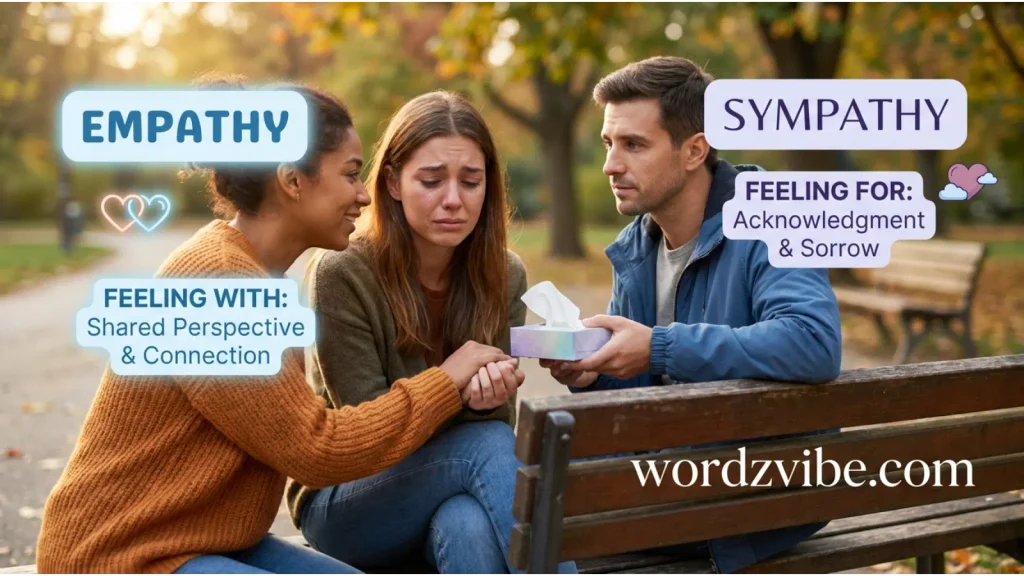
When I explain empathy vs sympathy, I usually put it simply: empathy means trying to understand and share another person’s feelings, while sympathy means feeling concern, sadness, or compassion for someone who is struggling.
I find this difference especially important today because the words appear in texts, friendships, workplaces, counseling, education, and social media. Knowing the difference helps me choose kinder and more accurate words when someone needs emotional support.
In this guide, I’ll show you how I distinguish empathy from sympathy, where the words came from, how I use them in real conversations, and which response may fit different situations. By the end, I want you to feel confident using both words naturally.
Quick Answer
- I use empathy when I try to understand another person’s feelings from their point of view.
- I use sympathy when I recognize someone’s pain and express care, concern, or sadness for them.
Empathy vs Sympathy at a Glance
I find the easiest way to understand empathy vs sympathy is to focus on emotional distance. With empathy, I mentally or emotionally step closer to another person’s experience, while sympathy allows me to care about their situation without necessarily experiencing the same emotion.
| Feature | Empathy | Sympathy |
|---|---|---|
| Definition | I try to understand another person’s feelings and perspective. | I feel concern or compassion for another person’s difficulty. |
| Tone | I usually sound understanding and emotionally connected. | I usually sound caring, supportive, and compassionate. |
| Best Use Case | I use it when someone wants to feel understood. | I use it when I want to acknowledge someone’s hardship. |
| Key Difference | I focus on understanding their emotional experience. | I focus on expressing concern about their experience. |
What Empathy Means to Me
When I use the word empathy, I mean making a genuine effort to understand what another person may be feeling. I do not have to experience exactly the same emotion, but I try to see the situation from their perspective.
For example, if my friend loses an important opportunity, I might say, I can understand why you feel disappointed after working so hard for it. I am focusing on their emotional experience rather than simply telling them that I feel sorry for them.
I often connect empathy with active listening because both require attention. Instead of quickly giving advice, I listen, acknowledge the feeling, and try to understand what the person is going through.
What Sympathy Means to Me
When I use sympathy, I am showing concern for someone who is experiencing pain, loss, disappointment, or another difficult situation. I can care deeply about someone without personally feeling the same emotion.
For instance, if a coworker tells me about a family loss, I might say, I am so sorry for your loss. That response expresses compassion and concern, which is a common use of sympathy.
I see sympathy as emotionally supportive, but it usually creates a little more distance than empathy. I recognize another person’s hardship without necessarily attempting to experience the situation through their perspective.
Empathy vs Sympathy in Real Communication
I notice the difference most clearly when people are having difficult conversations. If someone tells me they are overwhelmed, I can respond with sympathy by saying, I am sorry you are dealing with so much.
I can respond with empathy by saying, It sounds like you have been carrying a lot lately, and I can understand why you feel exhausted. The second response shows that I am trying to understand the person’s emotional position.
I also remind readers that neither word is automatically better. I choose based on the situation, the relationship, and what the other person seems to need at that moment.
The Origin and Etymology of Empathy
I find the history of empathy especially interesting because the modern English word is relatively recent. Empathy comes from the Greek word empatheia, which relates to feeling or passion, and the English term developed through German Einfühlung, meaning feeling into.
I understand modern empathy as an attempt to recognize and understand another person’s internal experience. The word later became important in psychology, philosophy, communication, and everyday discussions about emotional understanding.
I also avoid treating empathy as simply feeling exactly what another person feels. For me, it is more accurately about understanding or appreciating another person’s emotional experience from their perspective.
The Origin and Etymology of Sympathy
I trace sympathy much further back because it comes from Greek roots associated with suffering or feeling together. The English word developed through Latin and French before becoming established in English.
When I use sympathy today, I usually mean a feeling of concern, sorrow, or compassion toward another person. The word has also developed broader meanings in English, including agreement or support, although emotional concern remains one of its most familiar uses.
I think this history helps explain why sympathy can sound like sharing someone’s suffering. However, in modern everyday English, sympathy generally describes concern for another person rather than the deeper perspective taking associated with empathy.
Empathy vs Sympathy in Everyday Examples
I find examples much easier to remember than dictionary definitions. Here are a few situations where I would naturally choose one word over the other.
- If my friend says they feel nervous before an important interview, I might show empathy by acknowledging how stressful the situation feels.
- If my neighbor experiences a serious loss, I might express sympathy by offering my condolences.
- If a coworker feels ignored during a meeting, I might use empathy by listening carefully and recognizing why the experience hurt.
- If someone tells me about a difficult accident, I might express sympathy by saying that I am sorry they had to experience it.
- If a student feels anxious about an exam, I might show empathy by remembering how stressful academic pressure can feel.
These examples show me that context matters more than memorizing a single rule. I look at the emotional need first and then choose the word that communicates my intended response.
Empathy vs Sympathy in Professional Communication
I pay close attention to this distinction in workplace communication because emotional wording can affect how professional a message sounds. Empathy can help me acknowledge an employee’s feelings, while sympathy can help me express concern about a difficult circumstance.
For example, if a team member says they are struggling after a family emergency, I might write: I understand that this is a difficult time, and I appreciate you letting me know. Please take the time you need, and we can discuss the workload when you are ready.
In a formal setting, I avoid forcing emotional language into every message. I prefer sincere, respectful wording that recognizes the person’s situation without making the conversation unnecessarily personal.
Common Mistakes I See With Empathy and Sympathy
I often see one common mistake: people assume empathy always means experiencing exactly the same emotion as another person. I think that definition is too narrow because I can understand someone’s feelings without having lived through the same event.
Another mistake is treating sympathy as cold or uncaring. I do not agree with that view because sympathy can communicate genuine compassion, especially during grief, illness, loss, or serious personal difficulties.
I also avoid using the two words as perfect synonyms. Although they overlap in emotional communication, the difference in perspective can change the meaning of a sentence.
How I Remember the Difference
I remember empathy by thinking about perspective. I am trying to understand what another person may be feeling, thinking, or experiencing from their point of view.
I remember sympathy by thinking about concern. I recognize that someone is suffering and respond with compassion, care, or sorrow.
My simple memory trick is this: empathy moves me toward understanding the person’s experience, while sympathy helps me express care for the person’s difficulty. This small distinction makes the two words much easier for me to use correctly.
FAQ About Empathy vs Sympathy
Is empathy better than sympathy?
I would not say empathy is always better. I choose empathy when understanding is important and sympathy when expressing concern or compassion is more appropriate.
What is the main difference between empathy and sympathy?
I see the main difference as perspective. Empathy involves trying to understand another person’s feelings and experience, while sympathy involves feeling concern or compassion for their situation.
Can I use empathy and sympathy interchangeably?
I would avoid treating them as completely interchangeable. They can overlap, but empathy emphasizes understanding another person’s emotional experience, while sympathy emphasizes concern for that person.
Is sympathy a form of empathy?
I do not treat sympathy and empathy as identical concepts. They are related responses, but sympathy generally involves concern for someone, while empathy involves understanding their perspective or feelings.
Why is empathy vs sympathy important in communication?
I think empathy vs sympathy matters because choosing the right word can make my communication clearer and more sensitive. Understanding the distinction helps me respond appropriately in personal, academic, and professional situations.
Final Thoughts
I see empathy and sympathy as two valuable ways of responding to another person’s difficult experience. When I use empathy, I focus on understanding the person’s emotional perspective, while sympathy helps me express genuine concern for what they are facing.
For me, the biggest lesson from empathy vs sympathy is that context always matters. I do not need complicated language to show emotional intelligence; I simply need to listen carefully, understand the situation, and choose words that genuinely fit the moment.

My name is Muhammad Waseem, author at WordzVibe.com. With a Master’s degree in English and over 6 years of linguistic experience, I break down modern digital terms, viral slang, and word meanings into simple language. Every definition on this site is personally researched, written, and verified by me to ensure full accuracy and reliability.
4 thoughts on “Empathy vs Sympathy: What Is the Difference?”