

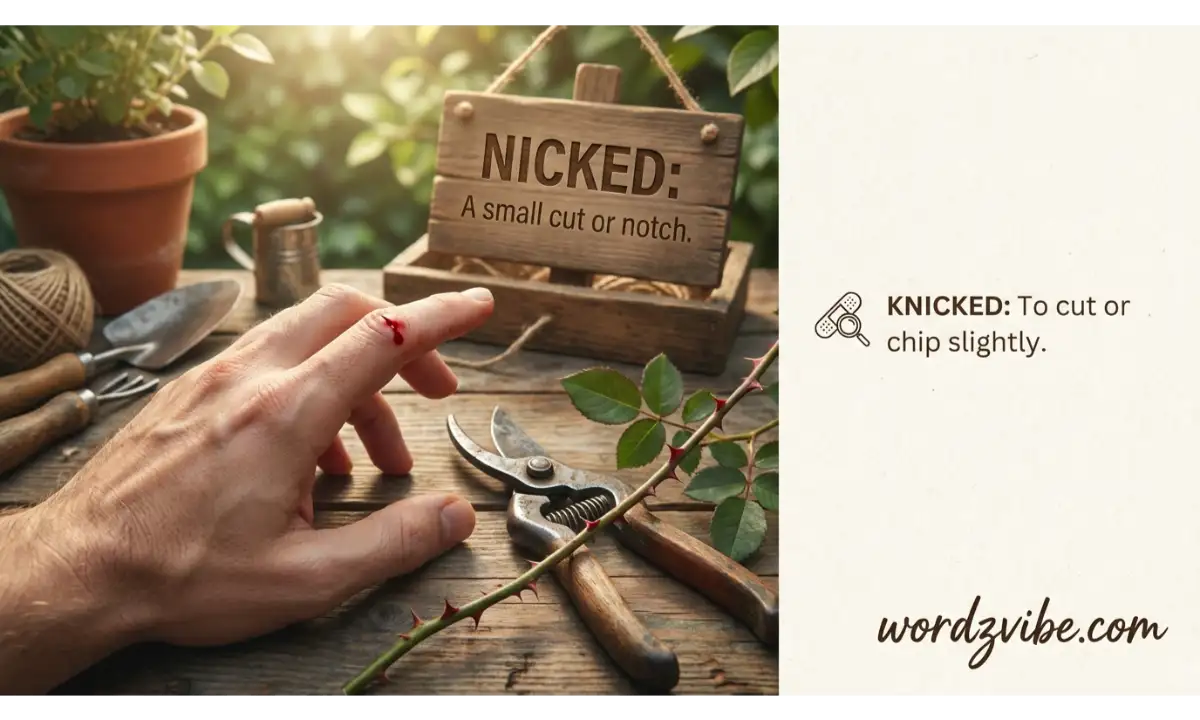
I often see writers pause over nicked or knicked because both forms look possible at first glance. In standard English, nicked is the correct spelling when we mean cut slightly, stole something, arrested someone, or used the British expression for being caught or stopped. Knicked is generally a misspelling when it is intended as the past tense or past participle of nick.
I find this confusion especially common because English has many words where a silent k appears naturally, such as knock, knife, and know. However, nick does not follow that pattern. Today, I will explain nicked or knicked, their meanings, pronunciation, grammar, examples, and correct usage so you can confidently choose the right spelling in everyday writing, schoolwork, workplace communication, and online conversations.
Quick Answer
- Nicked is the standard and correct spelling of the past tense and past participle of nick.
- Knicked is normally incorrect when you mean nicked.
- Nicked can mean slightly cut, stolen, arrested, or caught, depending on the context.
- In British English, nicked can commonly mean arrested or stolen.
Is Nicked or Knicked Correct?
When I compare nicked or knicked, I always choose nicked in standard English. The word comes from the verb nick, so its past tense and past participle are formed by adding -ed, giving us nicked.
The spelling knicked may appear because English contains many words beginning with kn, but that does not make it correct here.
- Correct: I nicked my finger while cutting the vegetables.
- Correct: Someone nicked my phone.
- Correct: The police nicked him for the offense.
- Incorrect in standard usage: I knicked my finger.
- Incorrect in standard usage: Someone knicked my phone.
I recommend remembering one simple rule: nick → nicked, not knick → knicked.
What Does Nicked Mean?
I use nicked differently depending on the sentence because nick has several established meanings. This is one reason the word can confuse learners and even native speakers.
The most common meanings include:
- Slightly cut or scratched: Something has received a small cut or notch.
- Stolen: In informal British English, nicked can mean stolen.
- Arrested: In British informal English, nicked can mean arrested by the police.
- Caught or stopped: In some informal contexts, it can suggest someone has been caught doing something.
- Copied or taken: Depending on context, nick can also describe taking something without permission.
For example, if I say, “I nicked the edge of the table,” I mean I made a small cut or mark. If I say, “Someone nicked my wallet,” I mean someone stole it.
Nicked or Knicked: Key Difference
I see the difference between these two forms as mainly a matter of correct spelling versus an incorrect spelling rather than two words with completely different meanings.
| Feature | Nicked | Knicked |
|---|---|---|
| Standard spelling | Correct | Generally incorrect |
| Base word | Nick | Knick |
| Past tense | Nicked | Not standard |
| Meaning | Cut, stole, arrested, caught, or took | Usually intended to mean nicked |
| Best use | Standard English writing | Avoid |
| Main difference | Established English word | Common spelling mistake |
When I edit content, I would replace knicked with nicked unless the writer is referring to a specific name, brand, or unusual proper noun.
Why Is Nicked Spelled With One K?
I find the spelling easier to remember when I look at the actual base word. The verb is nick, which already has its required k, so adding -ed gives nicked.
English spelling does not allow us to add another initial k simply because another word uses the letters kn.
- nick → nicked
- kick → kicked
- pick → picked
- lick → licked
I use these examples as a useful spelling pattern. The pronunciation also helps because the beginning of nick has a clear n sound rather than the silent-letter pattern found in words such as knife or know.
Nicked Meaning in British English
When I read British English, nicked can have meanings that sound surprising to American English speakers. Two especially common informal uses are stolen and arrested.
For example:
- “Someone nicked my bike” means someone stole my bike.
- “He got nicked by the police” means he was arrested.
- “My phone was nicked on the train” means my phone was stolen.
The exact meaning depends strongly on the surrounding words. In formal writing, I recommend using stolen or arrested when precision matters because those words are immediately clear to an international audience.
Nicked Meaning in American English
In American English, I more commonly encounter nicked in the sense of making a small cut, scratch, or notch. The informal British meanings can be understood, but they may sound distinctly British or unfamiliar to some American readers.
For example:
- “I nicked my hand while shaving.”
- “The knife nicked the surface.”
- “There is a nick in the wooden table.”
In these examples, nicked describes a minor cut or small mark. I would not automatically interpret it as stolen unless the sentence gives me a reason to do so.
How I Use Nicked in Everyday Sentences
When I explain this word to readers, I prefer simple examples because context makes the meaning obvious.
- I nicked my finger while cooking.
- The razor nicked his skin.
- Someone nicked my umbrella.
- She said her phone had been nicked.
- The police nicked him after the investigation.
- I accidentally nicked the paint on the door.
- Someone had nicked my seat before I returned.
- The scissors nicked the fabric.
I can tell from these examples that nicked does not have one fixed meaning. The surrounding words determine what the writer intends.
Nicked in Formal and Professional Writing
I recommend some caution with nicked in professional communication because several of its meanings are informal. A sentence such as “Someone nicked the office laptop” may be perfectly understandable, but someone stole the office laptop is more professional and precise.
For workplace writing, I prefer:
- Informal: Someone nicked my laptop.
- Professional: Someone stole my laptop.
- Informal British: He got nicked yesterday.
- Professional: He was arrested yesterday.
- Physical meaning: The blade nicked the surface.
- Professional technical wording: The blade caused a small cut on the surface.
This distinction matters because good writing is not only about spelling. I also consider audience, tone, regional English, and the level of formality.
Nicked vs Nick: Grammar Explained
I find the grammar straightforward once the base form is clear. Nick is the present or base form, while nicked is the simple past and past participle.
For example:
- Present: I nick the surface.
- Past: I nicked the surface.
- Present perfect: I have nicked the surface.
The same pattern works when nick means steal or arrest.
- Someone nicked my bag.
- The police nicked him.
- Someone has nicked my pen.
I would therefore avoid treating knicked as an alternative grammatical form. In ordinary English, nicked is the form you want.
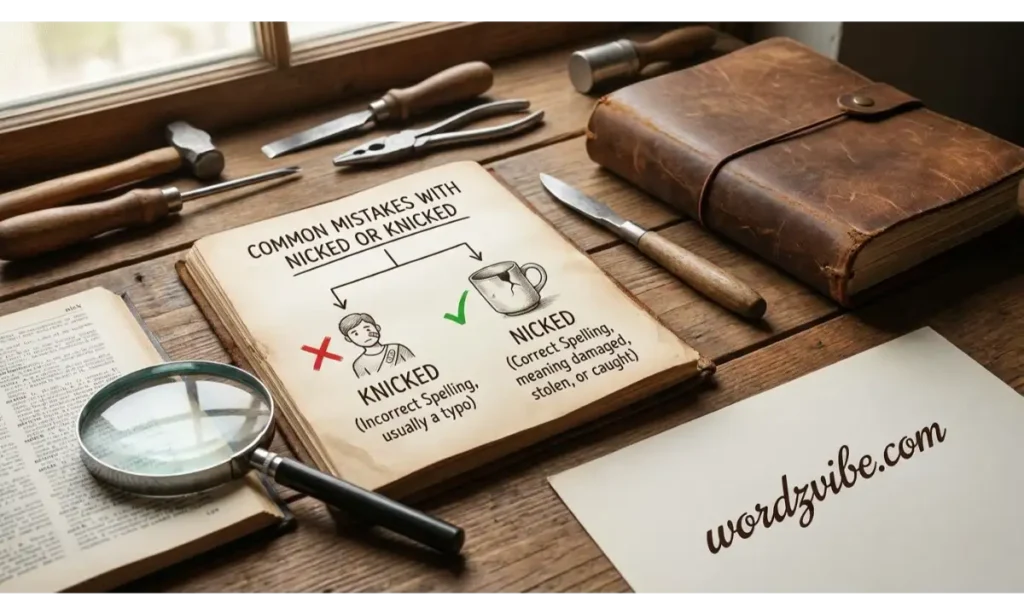
Common Mistakes With Nicked or Knicked
I often see spelling mistakes happen when writers rely on how other English words look instead of checking the base word. The presence of kn in words such as knee and knife can make knicked look believable.
Here are the mistakes I would watch for:
- ❌ Knicked my finger.
- ✅ Nicked my finger.
- ❌ Someone knicked my phone.
- ✅ Someone nicked my phone.
- ❌ He was knicked by the police.
- ✅ He was nicked by the police.
My easiest correction strategy is to remove the unnecessary k at the beginning. Once you remember the base word nick, the spelling becomes much easier.
Is Nicked a Real Word?
Yes. I consider nicked a completely legitimate English word because it is the standard past tense and past participle of nick.
Its meaning changes according to context. It can describe a small cut, stealing something, arresting someone, or other informal uses associated with the verb nick.
The important point is that nicked and knicked should not normally be treated as two standard spelling variants. Nicked is the established form in ordinary English.
Nicked or Knicked in a Workplace Email
I would choose my wording carefully in a professional email. If I mean that something was stolen, stolen is usually clearer than the informal word nicked.
For example:
“I noticed this morning that my laptop had been stolen from my desk.”
I would use nicked only when the communication is intentionally informal or when the audience is comfortable with British informal English.
This is a useful lesson I apply when editing English content: correct spelling is important, but appropriate vocabulary is equally important.
Nicked or Knicked: How to Remember the Correct Spelling
I use a simple memory trick: start with the dictionary form nick and add -ed.
Nick + ed = nicked.
I do not change the beginning of the word to knick. I also connect it with familiar words that follow a similar spelling pattern:
- Pick → picked.
- Kick → kicked.
- Sick → sickened.
- Nick → nicked.
Once I remember that nick is the base word, I no longer have a reason to write knicked.
Frequently Asked Questions
Nicked vs knicked
Nicked is the correct standard spelling. I use nicked as the past tense and past participle of nick, while knicked is generally a spelling error.
What does nicked mean in British English?
In British English, nicked can informally mean stolen or arrested. The intended meaning depends on the context of the sentence.
Does nicked mean stolen?
Yes, in informal British English, nicked can mean stolen. For example, “Someone nicked my phone” means someone stole my phone.
Does nicked mean arrested?
Yes. In informal British English, nicked can mean arrested by the police. I would use arrested instead in formal or international writing.
Why is nicked spelled without kn?
I spell it nicked because the base verb is nick, not knick. The extra k in knicked is not part of the standard spelling.
Final Thoughts
When I compare nicked or knicked, the answer is clear: nicked is the standard spelling. I also think the bigger lesson is that the meaning of nicked depends heavily on context, especially because British English gives the word informal meanings such as stolen and arrested.
I recommend remembering nick → nicked and avoiding knicked in normal English writing. When precision or professionalism matters, I would also choose clearer words such as cut, stolen, or arrested when they express the intended meaning more directly.

My name is Muhammad Waseem, author at WordzVibe.com. With a Master’s degree in English and over 6 years of linguistic experience, I break down modern digital terms, viral slang, and word meanings into simple language. Every definition on this site is personally researched, written, and verified by me to ensure full accuracy and reliability.
2 thoughts on “Nicked Or Knicked: Which Spelling Is Correct?”