

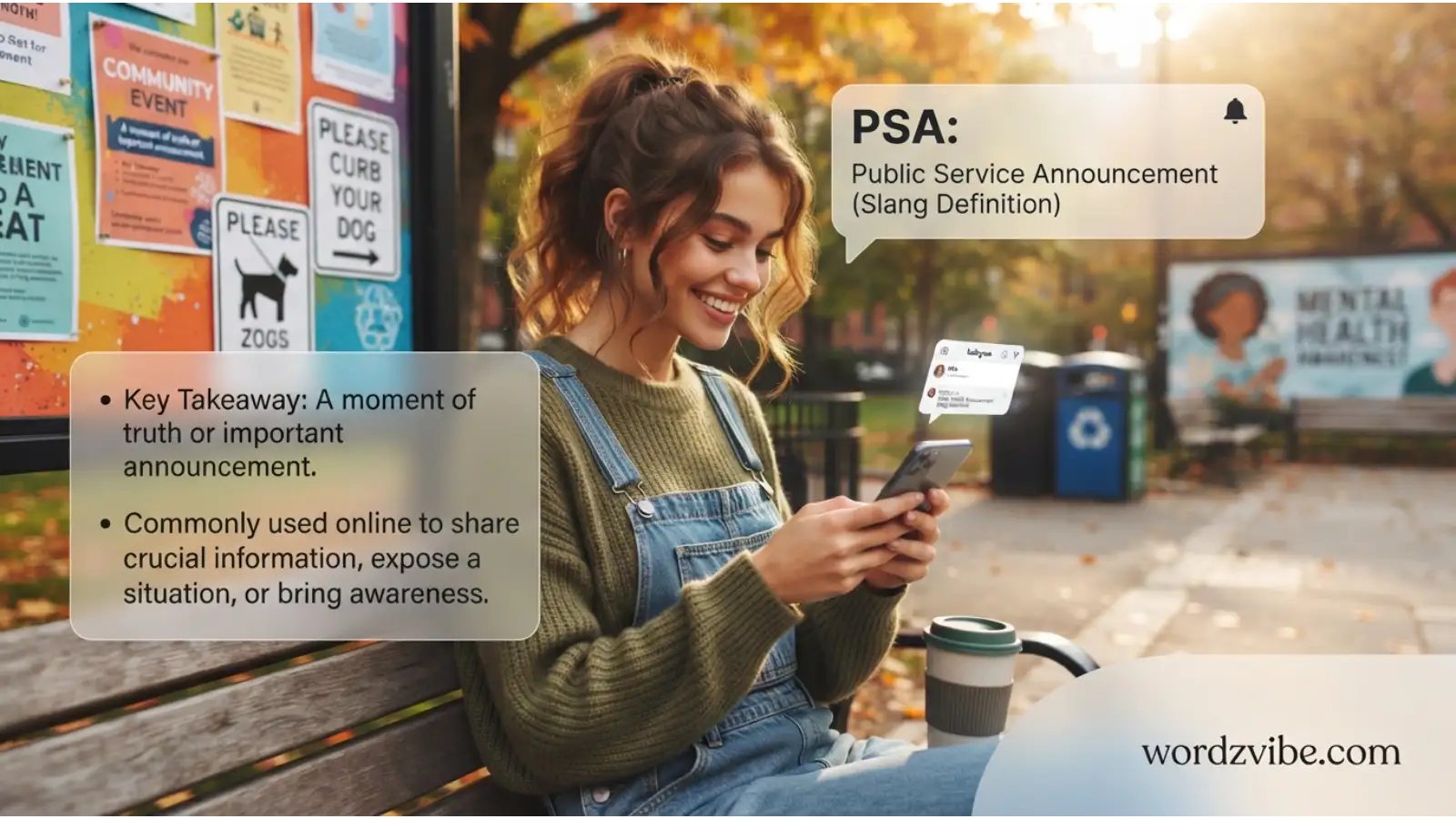
Have you ever seen someone write “PSA” in a group chat, social media post, or text message and wondered what they meant? The PSA meaning slang usually refers to a “public service announcement.” People use it to share information, give a reminder, correct a misunderstanding, or draw attention to something others should know.
Online, the phrase can be serious, helpful, funny, or slightly sarcastic, depending on the message. You might see it before a useful tip, an important warning, or even a playful comment about everyday life. Understanding the context helps you tell whether someone is sharing important information or simply making a casual announcement.
Quick Answer
PSA stands for public service announcement. In texting and online slang, people use it to introduce information, advice, reminders, or warnings they want others to notice. A PSA can be serious or humorous, and it does not always refer to an official announcement from an organization.

What Does PSA Mean in Slang?
In everyday online communication, PSA is a short way to introduce a message that the writer thinks people should know. Although the letters stand for “public service announcement,” people often use the abbreviation casually rather than for a formal public notice.
For example:
- “PSA: The store closes early today.”
- “PSA: You can freeze leftover bread.”
- “PSA: Please check your bag before leaving the café.”
Each message shares information that could help other people. The abbreviation signals that the writer wants readers to pay attention.
What Does PSA Mean in Texting?
In text messages, PSA usually introduces a reminder, tip, warning, or useful piece of information. Friends may use it in a group chat to tell everyone about a plan, point out something easy to miss, or share a small discovery.
For example:
Alex: “PSA: Our meeting starts at 9, not 10.”
Alex is reminding everyone about the correct time.
Mia: “PSA: The coffee machine is working again.”
Mia is sharing an update that may be useful to the group.
The message does not need to be serious or urgent. Sometimes, PSA simply makes an ordinary observation sound like an announcement to a wider audience.
How Is PSA Used on Social Media?
On social media, PSA often appears at the beginning of a post or caption. It helps introduce information the writer wants followers to notice, remember, or share.
Common examples include:
- A reminder about an event or schedule.
- Advice about a common problem.
- A correction to misleading information.
- A helpful tip about food, travel, or everyday tasks.
- A funny observation about a familiar situation.
For instance, someone might post, “PSA: Bring a jacket. The weather changes quickly here.” The abbreviation frames the advice as a useful reminder for anyone reading the post.
PSA does not have a separate, universal meaning on every platform. Its basic purpose remains the same: to draw attention to a message.
What Does PSA Mean on TikTok?
On TikTok, PSA can introduce a video that shares advice, a reminder, an opinion, or information about a particular subject. A creator might say “PSA” before explaining a useful tip or pointing out something viewers may have overlooked.
The tone depends on the video. One PSA might address a serious issue, while another might jokingly announce an everyday preference or complaint.
For example, “PSA: You can enjoy a movie without checking your phone every five minutes” could be a lighthearted comment about watching films.
The abbreviation itself does not guarantee that a video contains verified facts. If a PSA makes an important health, safety, or news-related claim, check the information before relying on it.
Can PSA Be Funny or Sarcastic?
Yes. People often use PSA humorously to make an ordinary thought sound like an important public announcement. The joke comes from treating a small matter as if everyone needs to hear it.
Examples:
- “PSA: Fries taste better when you steal one from a friend.”
- “PSA: Monday mornings should start after noon.”
- “PSA: The last slice of pizza is not automatically yours.”
These messages are playful rather than official warnings. Sarcasm may also appear when someone uses PSA to point out behavior they find annoying. Look at the wording and conversation to understand the intended tone.
Is PSA Formal or Informal?
PSA can be used in both formal and informal settings, but the tone depends on how it is presented.
In formal communication, a public service announcement may refer to an actual message intended to inform or protect the public. Organizations, schools, and public agencies may use announcements to share safety information or important updates.
In casual messages, PSA is often much less formal. Friends may use it to share a reminder or make a joke.
For a professional email, you can usually write “Important reminder” or “Please note” if those phrases fit your message better. In a casual group chat, PSA is generally easy to understand.
Examples of PSA in Everyday Conversations
Here are some original examples showing how the abbreviation works in different situations.
| Message | Intended meaning |
|---|---|
| “PSA: The deadline is Friday.” | A useful reminder. |
| “PSA: Save your work before updating your computer.” | Practical advice. |
| “PSA: The restaurant is closed on Sundays.” | Information people may need. |
| “PSA: Nobody wants spoilers before watching the movie.” | A request presented as a general announcement. |
| “PSA: Drink some water after your workout.” | A friendly reminder. |
In each case, PSA tells readers that the following information deserves their attention. It does not necessarily mean the information is urgent or officially verified.
How Should You Reply to PSA?
You do not need a special response when someone uses PSA. Reply according to the information they share and the tone of the conversation.
- To acknowledge a reminder: “Thanks for the heads-up!”
- To agree with advice: “Good point. I needed that reminder.”
- To respond humorously: “Thank you for this important announcement.”
- To ask for clarification: “Is that confirmed?”
- To respond to a serious warning: “Thanks for letting everyone know.”
If the announcement includes information that affects your plans or safety, confirm the details when necessary. The abbreviation introduces the message, but it does not prove that every claim is correct.

What Is the Difference Between PSA and FYI?
PSA and FYI both introduce information, but they often serve slightly different purposes.
| Term | Full form | Typical use |
|---|---|---|
| PSA | Public service announcement | Drawing attention to a reminder, warning, tip, or announcement for a group. |
| FYI | For your information | Sharing information someone may find useful or need to know. |
For example, “FYI, the office closes at five” simply passes along information. “PSA: The office closes at five today, so collect your documents early” sounds more like a general reminder to a group.
The distinction is not strict. In casual conversation, people sometimes use both abbreviations in similar ways.
Frequently Asked Questions
1. What does PSA mean in slang?
PSA means “public service announcement.” In slang and casual online communication, it introduces a reminder, tip, warning, or statement the writer wants people to notice.
2. What does PSA mean in a text from a friend?
A friend usually uses PSA to share information, remind everyone about something, or make a humorous announcement. The surrounding message tells you what they want you to know.
3. Does PSA mean something different on TikTok?
Its basic meaning remains “public service announcement.” On TikTok, it can introduce advice, information, opinions, or humorous observations rather than an official public notice.
4. Is PSA a rude expression?
No, PSA is not inherently rude. However, a sarcastic or critical announcement may sound passive-aggressive depending on the wording and the relationship between the people involved.
5. What is the difference between PSA and FYI?
PSA usually draws attention to a reminder or announcement intended for others, while FYI simply shares information. Their meanings can overlap in everyday messages.
Final Thoughts
The PSA meaning slang is usually “public service announcement,” used to introduce information, advice, reminders, or warnings. In texting and social media, it can sound serious, helpful, funny, or sarcastic.
Pay attention to the words that follow the abbreviation to understand the message. If you want to share something useful with a group, PSA is a simple way to get people’s attention.

“My name is Ali Sarfraz, Senior Content Strategist & Author at WordzVibe.com. Holding a Master’s degree in English Linguistics with over 6 years of dedicated research in digital communication, I specialize in decoding viral internet slang, trending acronyms, and modern word meanings. Every term I define undergoes a multi-step fact-checking process to ensure absolute precision, linguistic accuracy, and trust for our readers.”
1 thought on “PSA Meaning Slang: What Does PSA Mean in Text?”