

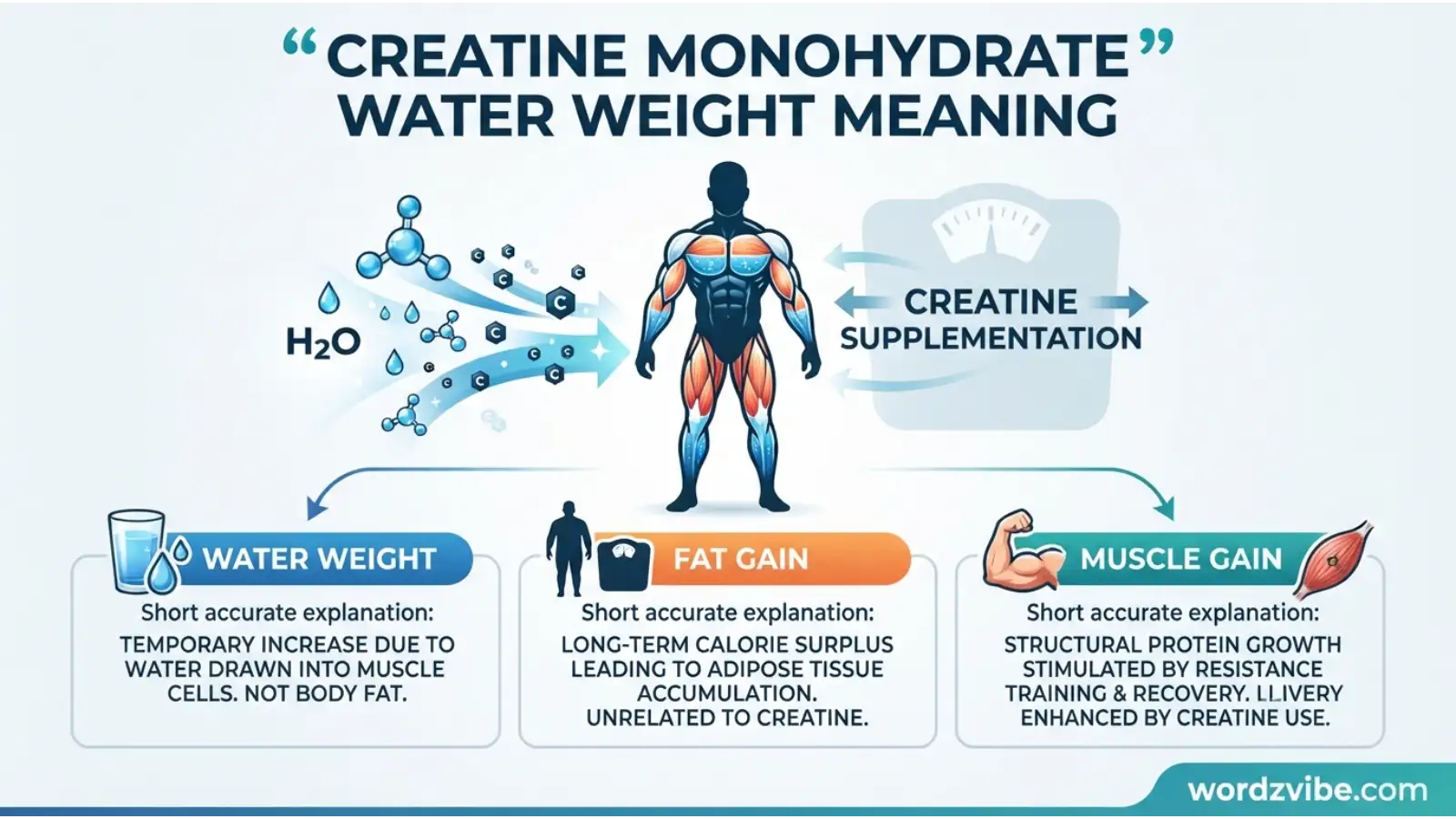
When I see someone worried about the scale going up after starting creatine, the first thing I look at is the timing. If the change happens soon after beginning creatine monohydrate, creatine monohydrate water weight meaning usually refers to an increase in body weight caused partly by additional water associated with creatine storage, particularly inside muscle cells.
Research has documented early increases in body water and body weight after creatine supplementation. This does not automatically mean that a person has gained body fat.
Creatine increases the muscles’ creatine and phosphocreatine stores, and early water changes can make the scale rise before longer-term training adaptations become noticeable.
I also think context matters because the amount and timing of weight change can differ between people, especially depending on whether someone uses a loading phase, their diet, training routine, and individual response.
Quick Answer
Creatine monohydrate water weight means the increase in scale weight that can occur when creatine supplementation increases water associated with muscle cells. This early change is not the same thing as gaining body fat, and research suggests that longer-term changes in body composition should not be explained by water retention alone.
What Does Creatine Monohydrate Water Weight Mean?
In simple terms, creatine monohydrate water weight is the extra body weight that may appear after taking creatine because creatine storage is associated with changes in body water. Early research found that creatine can increase total body water and body mass, particularly during the initial supplementation period.
I would not interpret every pound gained after starting creatine as fat or muscle. The scale measures total body mass, so water, food, glycogen, muscle tissue, and fat can all contribute to changes.

Why Does Creatine Cause Water Weight?
Creatine is osmotically active, meaning its presence in cells can influence water movement. When muscles take up additional creatine, water can accompany changes in cellular creatine content, especially during the early stages of supplementation.
This is why people sometimes notice a quick change on the scale. The effect is most commonly discussed during the first several days rather than as evidence that creatine causes continuous water accumulation indefinitely.
Is Creatine Water Weight or Fat?
Creatine-associated water weight is different from body-fat gain. Water has mass, so it can increase your scale reading even though it does not represent newly stored body fat.
Research has found increases in body water without corresponding increases in body-fat percentage in some creatine studies.
If someone’s weight rises after starting creatine, I would therefore avoid assuming that the entire increase represents fat. Diet and calorie intake still matter, but creatine itself does not provide meaningful calories that would directly create fat gain.
Does Creatine Make You Gain Weight?
Yes, creatine can cause an increase in body weight, particularly during the early stages of supplementation. Older research and sports-medicine reviews describe early weight gain as being associated with water retention, while later research indicates that longer-term changes can also involve increases in lean tissue when creatine is combined with resistance training.
The scale change is therefore not necessarily a negative outcome. For someone using creatine to support strength or high-intensity training, increased body mass can occur alongside useful training adaptations.
How Much Water Weight Can Creatine Cause?
There is no single number that applies to everyone. Research has reported different responses depending on the dose, supplementation protocol, exercise status, and individual characteristics.
A Cleveland Clinic explanation notes that some people may notice a few pounds of weight gain from creatine-related water retention.
I would treat any precise number as an estimate rather than a prediction. Your scale response may be smaller, larger, or barely noticeable.
When Does Creatine Water Weight Start?
Water-related weight changes can appear relatively quickly after supplementation begins. Research summarized in a major review describes increased water retention during the early stages, particularly during the first several days.
People using a loading protocol may notice changes sooner because they consume a much larger amount of creatine over a short period. A standard lower daily intake can increase muscle creatine stores more gradually.
How Long Does Creatine Water Weight Last?
The answer depends on what you mean by “water weight.” Early water changes may stabilize after muscle creatine stores become saturated rather than continuing to increase indefinitely.
This is an important distinction because the idea that creatine continuously makes you hold more and more water is not supported by the evidence. Some longer-term studies reviewed in the scientific literature have not found persistent increases in total body water relative to muscle mass.
Does Creatine Water Weight Mean Your Muscles Are Holding Water?
Often, the early water increase is discussed in relation to intracellular water, meaning water associated with the inside of muscle cells. Research has found evidence of increased intracellular volume after short-term creatine supplementation.
That is different from simply describing creatine as causing generalized swelling throughout the body. The location and type of water change matter when interpreting what the scale is showing.
Is Creatine Water Weight Bad?
Water-related weight gain from creatine is not automatically harmful in healthy people. Creatine monohydrate has been extensively studied, and evidence generally supports its use for improving certain aspects of high-intensity exercise performance when used appropriately.
However, I would not treat every supplement as appropriate for every person. People with kidney disease or other relevant medical conditions should discuss creatine use with a healthcare professional before starting supplementation. Cleveland Clinic specifically recommends medical guidance for people with certain health conditions.
Does Creatine Water Weight Mean You Are Bloated?
Not necessarily. Water associated with creatine storage and digestive bloating are different experiences.
Some people report gastrointestinal discomfort or bloating, particularly with larger doses or loading protocols. Cleveland Clinic notes that gastrointestinal effects and temporary fluid retention can occur, with some effects being more noticeable during loading.
If someone feels unusually bloated, I would consider the entire supplementation routine rather than assuming every sensation is caused by muscle water.
Creatine Loading and Water Weight
A loading phase generally involves taking a higher amount of creatine for several days before moving to a lower maintenance amount. Its purpose is to raise muscle creatine stores more quickly.
Loading is not essential for eventually increasing muscle creatine stores. Research indicates that lower daily supplementation can achieve similar saturation over a longer period.
Because loading involves more creatine over a short period, it may also make early weight changes or gastrointestinal effects more noticeable.
Does 5 Grams of Creatine Cause Water Weight?
A daily amount around 3–5 grams is commonly discussed in evidence-based guidance, although individual supplementation needs can differ. Lower daily supplementation generally raises muscle creatine stores progressively rather than producing the rapid saturation associated with a loading protocol.
That means someone taking a smaller daily amount may experience a more gradual change in body weight. It does not mean that everyone taking 5 grams will gain a specific amount of water.
Can Creatine Make You Look Bigger?
It can contribute to a fuller appearance in the muscles because changes in cellular water and increased muscle creatine storage can affect muscle volume. This is one reason some people notice that their muscles look or feel fuller after beginning supplementation.
Over time, resistance training and adequate nutrition can also contribute to genuine increases in lean tissue. I would therefore separate the immediate visual effect from longer-term muscle development rather than treating them as exactly the same process.
Is Creatine Water Weight the Same as Muscle Gain?
No. Water weight and muscle gain are related to different physiological changes.
Early scale increases can occur because of increased body water, while longer-term training can contribute to actual increases in muscle tissue. Evidence reviews specifically caution against explaining all body-mass changes from creatine as water retention alone.
For that reason, I prefer looking at trends in strength, measurements, training performance, and body composition instead of judging progress from one scale reading.
Does Creatine Cause Water Retention in the Whole Body?
The answer is more nuanced than the simple statement “creatine makes you retain water.” Early research supports an increase in body water, and some studies have observed changes in both intracellular and extracellular water during short supplementation periods.
However, longer-term research does not consistently show excessive generalized water retention. A major review concluded that the evidence for persistent increases in total body water is less clear after the early supplementation period.
What Does Creatine Water Weight Look Like on a Scale?
The scale may simply show a higher number. It cannot tell you whether that change came from water, fat, muscle, glycogen, food, or other normal fluctuations.
For example, someone could weigh 175 pounds before starting creatine and see a higher reading afterward without having gained an equivalent amount of body fat. Daily weight also naturally changes because of hydration, meals, sodium, carbohydrates, bowel contents, and other factors.
I recommend looking at several weigh-ins under similar conditions instead of reacting to a single measurement.
Creatine Water Weight vs Glycogen Water Weight
Creatine-related water changes and glycogen-related water changes are not identical. Creatine influences cellular hydration through increased creatine storage, while glycogen is the stored form of carbohydrate and is associated with water storage in muscle.
This distinction becomes useful when interpreting rapid weight changes after starting a new training program. Increased carbohydrate intake, increased glycogen storage, exercise-related inflammation, and creatine supplementation can all affect the scale at the same time.
How Can I Tell If Weight Gain Is From Creatine?
You cannot determine the exact source of a weight change from the scale alone. Timing can provide a clue, but it is not proof.
If weight rises shortly after starting creatine, water is one possible explanation. If calories have also increased substantially, fat gain may contribute; if resistance training has been consistent over a longer period, lean tissue may contribute as well.
I find it more useful to monitor several signals together:
- Average body weight over time.
- Waist or other body measurements.
- Training performance.
- Strength progression.
- Food intake.
- Progress photos under consistent conditions.

Should You Stop Creatine Because of Water Weight?
Not automatically. If the only concern is that the scale has increased slightly after beginning creatine, that does not by itself establish that something is wrong.
Creatine monohydrate is one of the most extensively studied forms of creatine, and evidence supports its effectiveness for certain exercise and performance outcomes.
However, unexplained swelling, significant symptoms, or concerns related to an existing medical condition deserve professional medical advice rather than a guess based on internet information.
How to Reduce Creatine-Related Water Weight
There is no reliable trick that should be used simply to eliminate normal muscle-associated water. If rapid scale changes are a concern, avoiding an aggressive loading phase may result in a more gradual increase in muscle creatine stores and potentially a less noticeable early weight change.
I would not recommend intentionally dehydrating yourself to manipulate the scale. Adequate hydration remains important, especially for people exercising regularly.
Should You Take Creatine If You Are Trying to Lose Weight?
Creatine and fat loss are not mutually exclusive. Taking creatine does not inherently mean that you are gaining body fat, although the scale can temporarily move upward because of water.
For someone tracking weight loss, this can be psychologically confusing. I would therefore monitor longer-term trends and consider waist measurements, strength, and other indicators instead of interpreting every early increase as failed fat loss.
Does Creatine Water Weight Go Away When You Stop?
Creatine stores gradually decline after supplementation stops, rather than disappearing immediately. As muscle creatine levels return toward baseline, associated changes in body water and body weight may also decline.
Cleveland Clinic notes that creatine levels gradually drop over the following weeks after stopping supplementation and that weight loss can occur during this period.
That change should not automatically be interpreted as losing the muscle tissue you gained through training.
Creatine Monohydrate vs Other Creatine Forms
Creatine monohydrate is the most extensively studied form of supplemental creatine. Research reviews have not established a clear advantage for alternative forms simply because they are marketed as more advanced or produce different water effects.
When I explain creatine to readers, I focus on the evidence rather than assuming a newer or more expensive form is automatically better. The form, dose, training program, diet, and individual response all matter when interpreting results.
Common Mistakes When Interpreting Creatine Water Weight
One common mistake is assuming that every pound gained after starting creatine is fat. Another is assuming that every increase is new muscle.
Other misunderstandings include:
- Treating normal water changes as a sign that creatine is unsafe.
- Assuming everyone gains the same amount of weight.
- Believing loading is mandatory.
- Comparing your scale response directly with someone else’s.
- Using daily weight instead of a longer-term trend.
- Assuming water weight means the supplement has permanently changed your body composition.
The simplest correction is to separate water, fat, and muscle rather than putting every change into one category.
Creatine Water Weight vs Similar Terms
| Term | Definition | Typical Context | Key Difference |
|---|---|---|---|
| Creatine water weight | Weight associated with changes in body water after creatine supplementation | Early creatine use | Connected with creatine storage |
| Fat gain | Increase in stored body fat | Sustained calorie surplus | Represents adipose tissue |
| Muscle gain | Increase in skeletal muscle tissue | Resistance training and adequate nutrition | Represents tissue growth |
| Glycogen water | Water associated with stored carbohydrate | Higher carbohydrate intake or restored glycogen | Linked to glycogen storage |
| Temporary fluid fluctuation | Short-term change in body water | Diet, exercise, hormones, hydration | Can happen without creatine |
This comparison is useful because several different processes can move the scale in the same direction.
What Is the Best Way to Track Creatine Weight Changes?
I recommend weighing yourself under similar conditions, such as at the same time of day and using the same scale. Instead of focusing on one reading, look at the pattern across multiple days.
It is also helpful to record training performance and body measurements. That gives you a broader picture than scale weight alone.
If the goal is fat loss, waist measurements and longer-term weight trends can be particularly useful. If the goal is strength or muscle development, performance changes can provide additional context.
Is Creatine Water Weight Permanent?
The early water-related increase is not necessarily permanent. When supplementation stops, muscle creatine levels gradually decrease, and some of the associated body-weight change may disappear over time.
At the same time, any genuine muscle gained through training should not be confused with temporary water changes. This is why the phrase “creatine weight” can be misleading when it is used as though every pound has the same biological meaning.
Frequently Asked Questions
Does creatine monohydrate water weight mean fat gain?
No. Creatine monohydrate water weight generally refers to an increase in body weight associated with changes in body water. It should not automatically be classified as body-fat gain.
How quickly can creatine water weight appear?
It can appear during the early stages of supplementation, with some studies reporting changes within the first several days. The response varies between individuals and supplementation protocols.
Does creatine make you look bloated?
Not necessarily. Creatine-related water changes are often associated with muscle cells, while gastrointestinal bloating is a separate experience that some people may notice, particularly with larger doses or loading.
Is creatine appropriate for professional communication?
The term is not slang or internet shorthand, so there is no special communication issue. “Creatine monohydrate” is a standard scientific and nutritional term and can be used in professional, academic, medical, or fitness discussions.
Should I worry if my weight rises after starting creatine?
A modest early increase does not automatically indicate a problem. If you have a medical condition, develop concerning symptoms, or are unsure whether creatine is appropriate for you, discuss supplementation with a qualified healthcare professional.
Final Thoughts
When I hear someone ask about creatine monohydrate water weight meaning, I think the most important point is to separate a scale reading from what is actually happening inside the body. Creatine can increase body weight during the early supplementation period, and changes in body water are a recognized part of that response.
The key is context. Water weight is not the same as fat gain, and longer-term changes in muscle mass should not be reduced to water retention alone. If you use creatine, track your overall trend rather than letting one unexpected weigh-in determine how you judge your progress.
For most readers, the simplest takeaway is this: an early increase on the scale after starting creatine can reflect increased muscle-associated water, but the scale alone cannot tell you exactly what caused the change.

My name is Muhammad Waseem, author at WordzVibe.com. With a Master’s degree in English and over 6 years of linguistic experience, I break down modern digital terms, viral slang, and word meanings into simple language. Every definition on this site is personally researched, written, and verified by me to ensure full accuracy and reliability.
1 thought on “Creatine Monohydrate Water Weight Meaning In Everyday life”