

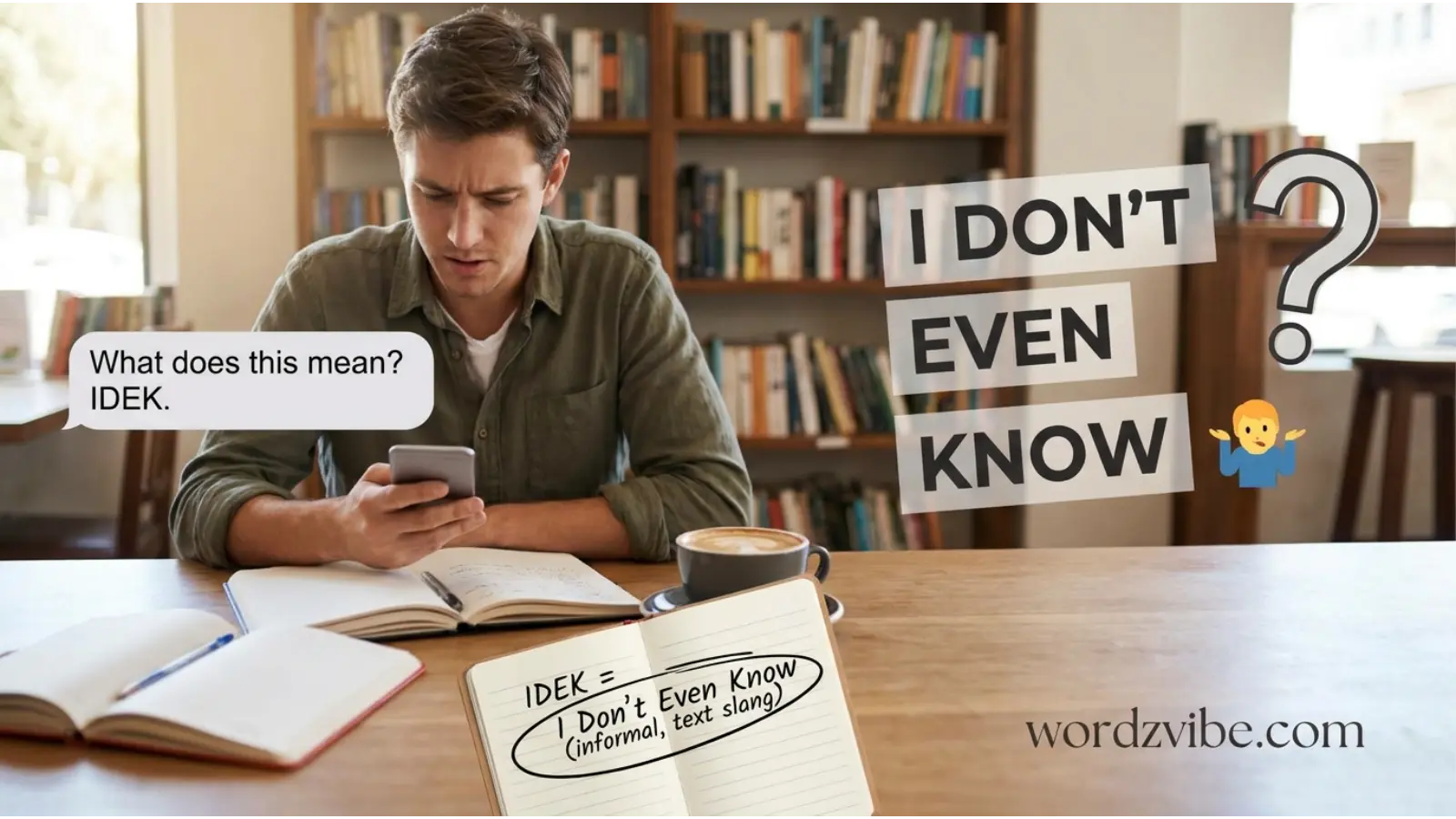
I often see short texting abbreviations that look confusing at first, and idek meaning in text is one of the common ones people ask me about. When I see IDEK in a message, I understand it as I don’t even know, a casual phrase people use when they are unsure, confused, surprised, or simply do not have an answer.
I use IDEK mostly in informal digital conversations because it sounds relaxed and natural among friends, family members, and people who are comfortable with texting slang. I would not normally use it in a formal email, school assignment, job application, or professional message because the abbreviation can sound too casual.
If you are searching for idek meaning in text today, I will explain its meaning, tone, origin, examples, and proper usage so you can recognize it confidently.
Quick Answer
- IDEK means I don’t even know.
- I use it in casual texts when I feel unsure, confused, surprised, or unable to give an answer.
- I consider it informal texting slang, so I avoid it in professional or academic communication.
IDEK Meaning in Text Explained
When I explain idek meaning in text, I simply expand it to I don’t even know. The word even adds extra emphasis, so the phrase can show stronger uncertainty than a basic I don’t know.
I commonly see IDEK when someone has no clear answer or feels confused about something. Depending on the conversation, it can sound neutral, funny, frustrated, surprised, or slightly annoyed.
For example:
- IDEK what happened.
- IDEK where my phone is.
- IDEK why she left so early.
- IDEK what to say right now.
I always recommend checking the surrounding message because the same abbreviation can carry different emotions depending on the situation.
What Does IDEK Mean in Texting?
When someone sends me IDEK, I read it as a shortened form of I don’t even know. It usually tells me that the person does not know the answer or cannot explain something clearly.
I often notice it in quick conversations where people want to respond without typing a complete sentence. It saves time while still communicating uncertainty.
I may interpret IDEK in several ways depending on context:
- I genuinely do not know.
- I am confused.
- I have no idea.
- I cannot explain it.
- I am surprised by what happened.
- I do not know what to say.
- I am slightly frustrated.
The surrounding words help me understand the intended emotion.
IDEK Meaning and Emotional Tone
I find the tone of IDEK especially interesting because it is not limited to one emotion. A person can use it casually, humorously, or seriously depending on the conversation.
For example, IDEK what movie to watch usually sounds casual and harmless. However, IDEK why you did that can sound confused, disappointed, or even annoyed.
I usually look at punctuation, emojis, previous messages, and the relationship between the speakers before deciding how the phrase sounds.
| Meaning | Tone | Best Use Case | Key Difference |
|---|---|---|---|
| I don’t even know | Casual | Texting with friends | Original full phrase |
| IDEK | Informal | Quick digital chats | Shortened version |
| I don’t know | Neutral | Casual or formal situations | Less emphasis |
| I have no idea | Neutral to casual | General conversation | Can show stronger uncertainty |
| I’m not sure | Polite | Professional or everyday communication | Softer and more careful |
Where I Use IDEK in Real Communication
I mainly see IDEK in texting, social media comments, direct messages, gaming chats, and other informal online conversations. It fits naturally when people already understand common internet abbreviations.
I would feel comfortable using it with a close friend who regularly uses texting slang. I would avoid it when writing to a manager, teacher, client, interviewer, or someone I do not know well.
For example, a casual conversation might look like this:
Friend: Do you know why Jake canceled the trip?
Me: IDEK. He just texted me that he cannot go.
Here, IDEK sounds completely natural because the conversation is informal.
Can I Use IDEK in Professional Communication?
I do not recommend using IDEK in most professional communication. Although many people understand the abbreviation, it can make a message appear overly casual or less polished.
If I need to communicate uncertainty at work, I prefer clearer alternatives such as I’m not sure, I don’t have that information yet, or I’ll check and let you know.
For example, instead of writing:
IDEK when the report will be ready.
I would write:
I’m not sure when the report will be ready, but I’ll confirm the timeline and let you know.
That version sounds more professional and gives the reader useful information.
IDEK Meaning in Casual Conversations
I find IDEK especially common in casual conversations because it lets people express uncertainty quickly. Friends may use it when discussing plans, relationships, entertainment, school, work, or unexpected situations.
Some natural examples include:
- IDEK what I want for dinner.
- IDEK how that happened.
- IDEK if I can make it tonight.
- IDEK what she meant by that.
- IDEK why everyone is laughing.
- IDEK where we should go.
- IDEK what happened yesterday.
- IDEK how to fix this.
I would read all of these as informal expressions of uncertainty.
Is IDEK Rude?
I do not consider IDEK rude by itself. However, I know the tone can change depending on the words around it and the relationship between the people communicating.
For example, IDEK lol can sound playful and relaxed. On the other hand, IDEK, ask someone else may sound dismissive or irritated.
I always advise readers not to judge the abbreviation alone. The complete message and the situation usually tell me much more about the speaker’s intention.
Origin and Background of IDEK
I understand IDEK as an internet abbreviation created by shortening the phrase I don’t even know. Like many texting abbreviations, it developed from the broader habit of shortening common expressions for faster digital communication.
I would not treat IDEK as a formal English word. It belongs to informal online language, where abbreviations such as IDK, LOL, BRB, and IMO became common because quick communication often favors shorter forms.
The exact first use of IDEK is difficult to establish from everyday internet communication because informal slang develops across many communities and platforms. I therefore describe its background as digital shorthand rather than assigning it to one specific person or event.
IDEK vs IDK
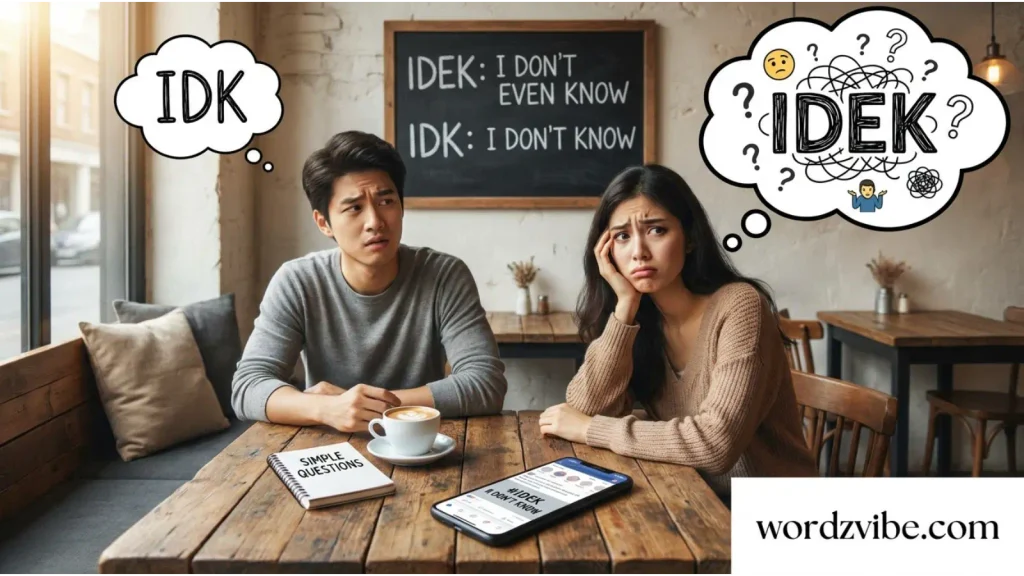
I often see readers confuse IDEK with IDK because both expressions communicate uncertainty. The important difference is the word even, which adds emphasis to IDEK.
| Abbreviation | Full Meaning | Tone | Example |
|---|---|---|---|
| IDEK | I don’t even know | More emphatic | IDEK what happened. |
| IDK | I don’t know | Neutral and casual | IDK what happened. |
I use IDK when I simply do not know something. I use IDEK when I want to emphasize that I really do not know, feel confused, or have no idea what is going on.
How I Know When Someone Means IDEK
When I see IDEK in a message, I check the context before interpreting the emotion. This helps me avoid assuming that the sender is angry, confused, or joking without enough evidence.
I usually consider these clues:
- The words before and after IDEK.
- The punctuation used by the sender.
- Emojis or reaction symbols.
- The relationship between the people.
- The overall mood of the conversation.
- The topic being discussed.
For example, IDEK 😂 will often feel playful, while IDEK why you keep doing this may carry frustration.
FAQ About IDEK Meaning in Text
What does IDEK mean in text?
When I see IDEK meaning in text, I explain it as I don’t even know. It is an informal abbreviation used mainly in texting and online conversations.
Is IDEK the same as IDK?
I consider them very similar, but not exactly the same. IDK means I don’t know, while IDEK means I don’t even know, which can add extra emphasis.
Is IDEK a slang word?
I classify IDEK as informal internet and texting slang. I mainly use it in casual digital conversations rather than formal writing.
Can I use IDEK at work?
I recommend avoiding IDEK in formal workplace communication. I would use I’m not sure or I don’t have that information yet when I want my message to sound professional.
What is the emotional meaning of IDEK?
I find that IDEK can express uncertainty, confusion, surprise, frustration, or casual indifference. The exact emotion depends on the context and surrounding words.
Final Thoughts
I see idek meaning in text as a simple example of how digital communication changes everyday English. The abbreviation means I don’t even know, and I mainly use it when I want to express uncertainty in a quick, casual way.
I always remind readers that context matters more than the abbreviation alone. If I understand the conversation, relationship, and tone, I can usually tell whether IDEK sounds confused, humorous, surprised, or frustrated.

My name is Muhammad Waseem, author at WordzVibe.com. With a Master’s degree in English and over 6 years of linguistic experience, I break down modern digital terms, viral slang, and word meanings into simple language. Every definition on this site is personally researched, written, and verified by me to ensure full accuracy and reliability.
1 thought on “IDEK Meaning in Text: What Does IDEK Mean in Texting?”