

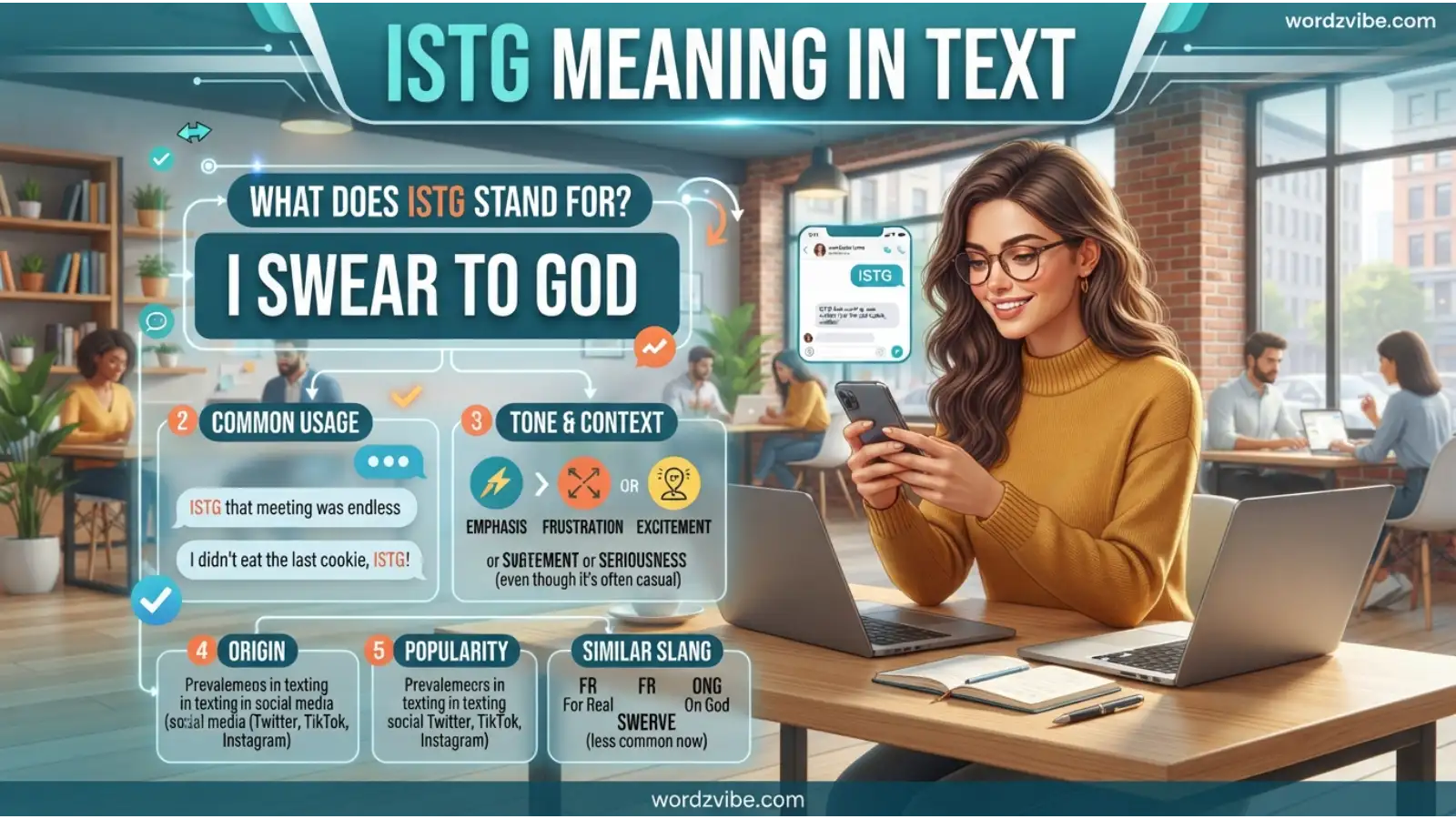
When someone sends ISTG in a text, the meaning can be confusing if you have not seen the abbreviation before. I usually read it as a strong way of saying “I swear to God,” often used to emphasize that someone is being serious, telling the truth, expressing frustration, or strongly reacting to something. Its exact tone depends on the surrounding conversation.
In casual texting, ISTG can sound sincere, dramatic, annoyed, humorous, or even playful. For example, someone might write “ISTG, I left my keys on the table” to emphasize that they are certain. Another person might use “ISTG this game is impossible” simply to exaggerate their frustration.
Since the phrase refers to God, some readers may also consider it religious or too strong for certain conversations. This guide explains ISTG meaning in text, its full form, tone, examples, appropriate usage, and natural ways to reply.
Quick Answer
ISTG meaning in text is “I swear to God.” It is an informal texting abbreviation used to emphasize sincerity, frustration, disbelief, annoyance, or a strong reaction. The meaning can sound serious or humorous depending on the context.
What Does ISTG Mean in Text?
ISTG stands for “I swear to God.” In texting, people use it to add emphasis to what they are saying.
For example, “ISTG I told you already” means something like “I swear to God, I told you already.” The abbreviation makes the message shorter while preserving the emotional force of the original phrase.
It is generally associated with informal digital communication. The surrounding words and punctuation often determine whether ISTG sounds serious, annoyed, dramatic, or funny.

What Is the Full Form of ISTG?
The full form of ISTG is “I swear to God.”
It is an initialism because the letters come from the first letters of the words:
- I = I
- S = Swear
- T = To
- G = God
People commonly type ISTG in uppercase, although lowercase istg is also common in casual messages.
How Do You Pronounce ISTG?
When used as an abbreviation, ISTG is normally read as the individual letters “I-S-T-G.”
In a conversation, however, a reader may mentally expand it to “I swear to God.” Unlike some internet abbreviations that become spoken words, ISTG is generally understood as a sequence of letters.
Why Do People Use ISTG?
People use ISTG mainly to make a statement sound stronger.
It can emphasize that the sender is:
- Being truthful.
- Very frustrated.
- Serious about a statement.
- Surprised or shocked.
- Annoyed by a situation.
- Making a dramatic reaction.
- Strongly insisting on something.
The abbreviation can therefore carry more emotion than a simple statement.
Is ISTG Considered Slang?
Yes, ISTG is generally considered informal internet and texting language.
You are more likely to see it in texts, social media posts, group chats, comments, and direct messages than in formal writing. It is not normally appropriate when writing a formal business letter or academic paper.
Its casual nature is one reason people use it so freely online.
What Tone Does ISTG Convey?
ISTG does not have one fixed emotional tone.
It can communicate seriousness, frustration, emphasis, disbelief, annoyance, or humor. Context is important.
For example:
“ISTG I didn’t take your charger.”
This may sound defensive and serious.
By contrast:
“ISTG this cat knows when I’m trying to sleep.”
This could be a humorous exaggeration rather than an actual serious statement.
Can ISTG Sound Rude?
ISTG can sound rude when it is used during an argument or directed at someone in an aggressive way.
For example:
“ISTG, stop doing that.”
The phrase can make the message sound more forceful than simply saying “Please stop doing that.”
However, friends may use the same abbreviation playfully. The relationship between the speakers, conversation history, punctuation, and subject all influence how it is received.
Is ISTG Positive or Negative?
ISTG itself is neither strictly positive nor negative.
Its emotional meaning comes from the sentence around it. Someone might use it positively:
“ISTG, that was the funniest movie ever.”
They might also use it negatively:
“ISTG, I’m so tired of this.”
It can even be neutral when someone is strongly confirming a fact.
How Does Context Change ISTG Meaning?
Context can completely change how ISTG feels.
Consider these two messages:
“ISTG you look amazing today!”
This could be an enthusiastic compliment.
Now consider:
“ISTG you never listen to me.”
This sounds frustrated or annoyed.
The abbreviation stays the same, but the surrounding language changes the emotional interpretation. I would therefore avoid interpreting ISTG from the abbreviation alone.
How Is ISTG Used in Casual Chat?
In casual chat, ISTG often appears at the beginning or middle of a sentence.
Examples include:
“ISTG I just saw him five minutes ago.”
“This is the third time, ISTG.”
“ISTG, that was so funny.”
It works best when the conversation is already informal. Friends and people who regularly use texting slang are more likely to understand it immediately.
ISTG Examples in Text Messages
Here are some natural examples:
“ISTG I didn’t delete your message.”
The sender strongly insists that they did not delete it.
“ISTG this traffic is never ending.”
The sender is expressing frustration.
“ISTG, you made my whole day.”
The sender is strongly emphasizing appreciation.
“ISTG I thought today was Friday.”
The sender emphasizes surprise or disbelief about their mistake.
“ISTG this dog is too cute.”
The phrase adds playful emotional emphasis.

ISTG in Social Media Conversations
ISTG can appear in comments, captions, replies, and private messages on social platforms.
A person might write:
“ISTG this video gets funnier every time.”
Here, the abbreviation adds dramatic emphasis.
Someone might also comment:
“ISTG, I need this outfit.”
That usage can be playful and exaggerated rather than literal.
The meaning generally remains “I swear to God,” rather than becoming a completely different platform-specific expression.
Is ISTG Appropriate at Work?
ISTG is usually too casual for formal workplace communication.
For example, instead of writing:
“ISTG I sent the report yesterday.”
A professional message could say:
“I can confirm that I sent the report yesterday.”
The second version communicates the same basic idea without relying on texting slang or religious wording.
In a workplace chat with close colleagues, people may use ISTG informally, but the appropriateness depends on the workplace culture and relationship.
When Should You Use ISTG?
Use ISTG mainly when communicating casually with people who understand internet slang.
It can work well when you want to:
- Emphasize a statement.
- Express frustration.
- Show strong emotion.
- Make a humorous exaggeration.
- Insist that something is true.
- React dramatically to an event.
I would avoid it when the message needs to sound formal, neutral, or highly professional.
When Should You Avoid ISTG?
Avoid ISTG when you are writing formal or sensitive communication.
That includes situations such as:
- Academic assignments.
- Formal business emails.
- Official documents.
- Job applications.
- Customer-service messages.
- Serious professional complaints.
- Communications with people unfamiliar with texting slang.
You should also consider the religious reference. Some people may prefer not to use or receive expressions involving God, so a neutral alternative may be more appropriate.
How Should I Reply to ISTG?
Your reply depends on what the sender is trying to communicate.
If they are insisting on something, you could respond:
“Okay, I believe you.”
If they are frustrated:
“I know, that sounds really annoying.”
If they are joking:
“Haha, seriously?”
If they are making a strong claim:
“Got it. I understand what you mean.”
There is no single correct response because ISTG can express several different emotions.
What Does ISTG Mean in a Funny Message?
In humorous messages, ISTG often works as a form of exaggeration.
For example:
“ISTG my phone waits until I’m busy to die.”
The person is not necessarily making a literal oath. They are using the phrase to make their frustration sound more dramatic and funny.
This type of usage is common in casual online communication.
What Does ISTG Mean in an Argument?
During an argument, ISTG can make a statement sound more intense.
For example:
“ISTG, I already explained this.”
Here, the sender is strongly emphasizing that they have explained something before.
The abbreviation can make the message feel impatient or frustrated. If the conversation is already tense, using ISTG may increase that intensity.
Is ISTG Offensive?
ISTG is not automatically offensive, but some people may find the religious wording inappropriate or uncomfortable.
Its acceptability depends on personal beliefs, social setting, and context. In casual conversations among people who commonly use the phrase, it may attract little attention.
In formal or religiously sensitive settings, a neutral alternative may be safer.
Common Mistakes When Using ISTG
One common mistake is assuming that ISTG always expresses anger.
It can also express sincerity, excitement, surprise, humor, or strong agreement.
Another mistake is using it in a formal email where an ordinary phrase would communicate the same idea more professionally.
It is also easy to misunderstand the tone when ISTG appears without context. Looking at the complete message usually gives a better indication of what the sender intends.
ISTG vs Similar Expressions
| Term | Meaning | Tone | Best Use Case | Key Difference |
|---|---|---|---|---|
| ISTG | I swear to God | Strong, emotional | Casual texting | Uses a religious oath for emphasis |
| TBH | To be honest | Direct, casual | Sharing an opinion | Focuses on honesty |
| FR | For real | Casual, emphatic | Agreement or emphasis | Usually shorter and less intense |
| IKR | I know, right? | Casual, conversational | Agreement | Shows shared reaction |
| OMG | Oh my God | Emotional | Surprise or excitement | Usually reacts to something rather than insisting on truth |
Related Texting Expressions
Several abbreviations can appear in conversations where ISTG is used.
FR means “for real” and often emphasizes sincerity or agreement.
TBH means “to be honest” and introduces a candid opinion.
OMG means “oh my God” and commonly expresses surprise, excitement, or shock.
IKR means “I know, right?” and signals agreement with another person’s reaction.
These expressions can overlap emotionally, but they do not have exactly the same function as ISTG.
Does Capitalization Change ISTG?
Usually, capitalization does not change the basic meaning.
ISTG, istg, and sometimes Istg can all mean “I swear to God.”
Capital letters may make the abbreviation look slightly more emphatic or visually prominent, but the emotional tone usually comes from the surrounding sentence rather than capitalization alone.
Is ISTG Still Used in Texting?
ISTG remains recognizable as an informal texting abbreviation, particularly in casual online communication.
Its meaning is relatively straightforward because it is based on the initials of a familiar phrase. Still, individual usage varies, and not every reader will interpret its tone in exactly the same way.
If your audience may not know internet abbreviations, writing the full phrase can make your meaning clearer.

The Origin and Evolution of ISTG
ISTG is an initialism formed from the phrase “I swear to God.”
The exact point when ISTG became established as a common internet abbreviation is difficult to identify precisely. Like many texting abbreviations, it developed from the broader practice of shortening frequently used expressions in digital communication.
Its basic function has remained consistent: adding emphasis to a statement.
How ISTG Fits Into Modern Internet Language
ISTG reflects a broader pattern in online communication: people shorten familiar phrases to communicate quickly while preserving emotional meaning.
Texting abbreviations can also add personality. A short expression such as ISTG may make a message feel more spontaneous, dramatic, or conversational than a fully written sentence.
At the same time, not every audience is familiar with every abbreviation. Clear communication still depends on knowing who you are talking to.
Frequently Asked Questions
1. What does ISTG mean in text?
ISTG means “I swear to God.” It is an informal abbreviation used to emphasize sincerity, frustration, surprise, or another strong reaction.
2. Is ISTG slang?
Yes. ISTG is generally considered informal texting and internet slang. It is commonly used in casual digital conversations rather than formal writing.
3. Is ISTG rude?
ISTG is not automatically rude. It can sound frustrated or aggressive in an argument, but friends may also use it humorously or playfully.
4. Can I use ISTG at work?
It is usually better to avoid ISTG in formal workplace communication. A clearer phrase such as “I can confirm” or “I assure you” may be more appropriate.
5. What should I say when someone texts ISTG?
Your response depends on the context. You might say “I believe you,” “I know,” or “Seriously?” if the sender is joking or reacting emotionally.
Final Thoughts
ISTG meaning in text is “I swear to God,” but the emotional message can vary significantly. I would look at the entire conversation before deciding whether the sender sounds serious, frustrated, playful, surprised, or simply emphatic.
Because ISTG is informal, it fits best in casual texting and online conversations. It may be less suitable for professional or sensitive communication, especially when the religious wording could feel inappropriate. The safest approach is to consider the relationship, context, and tone before using or interpreting it.

My name is Muhammad Waseem, author at WordzVibe.com. With a Master’s degree in English and over 6 years of linguistic experience, I break down modern digital terms, viral slang, and word meanings into simple language. Every definition on this site is personally researched, written, and verified by me to ensure full accuracy and reliability.
4 thoughts on “ISTG Meaning in Text, What It Means and How to Use It”